
The Ultimate Cowhide Rug Buying Guide (Everything You Need to Know Before Buying a Cowhide Rug)

Table of Contents
There is a reason cowhide rugs keep showing up in interior design magazines, luxury Airbnb listings, ranch-style homes, and modern city apartments at the same time. They work in almost any space. They last for years. And no two of them look exactly the same which is something very few home décor products can honestly claim.
Walk into a well-designed living room today and there is a good chance you will find a cowhide rug anchoring the seating area. It might be a bold black-and-white hide underneath a mid-century sofa, a rich brindle spread across wide-plank hardwood in a farmhouse kitchen, or a tricolor piece layered over jute in a coastal-inspired bedroom. The style changes. The rug stays relevant.
That kind of versatility does not happen by accident. Genuine cowhide is one of the few natural materials that moves between décor styles without looking forced. It brings warmth to minimalist rooms, texture to modern spaces, and authenticity to rustic or western interiors. Interior designers reach for it because it solves a specific problem: how do you add visual interest to a room without making it feel overdone?
So Why Does Buying a Cowhide Rug Feel So Complicated?
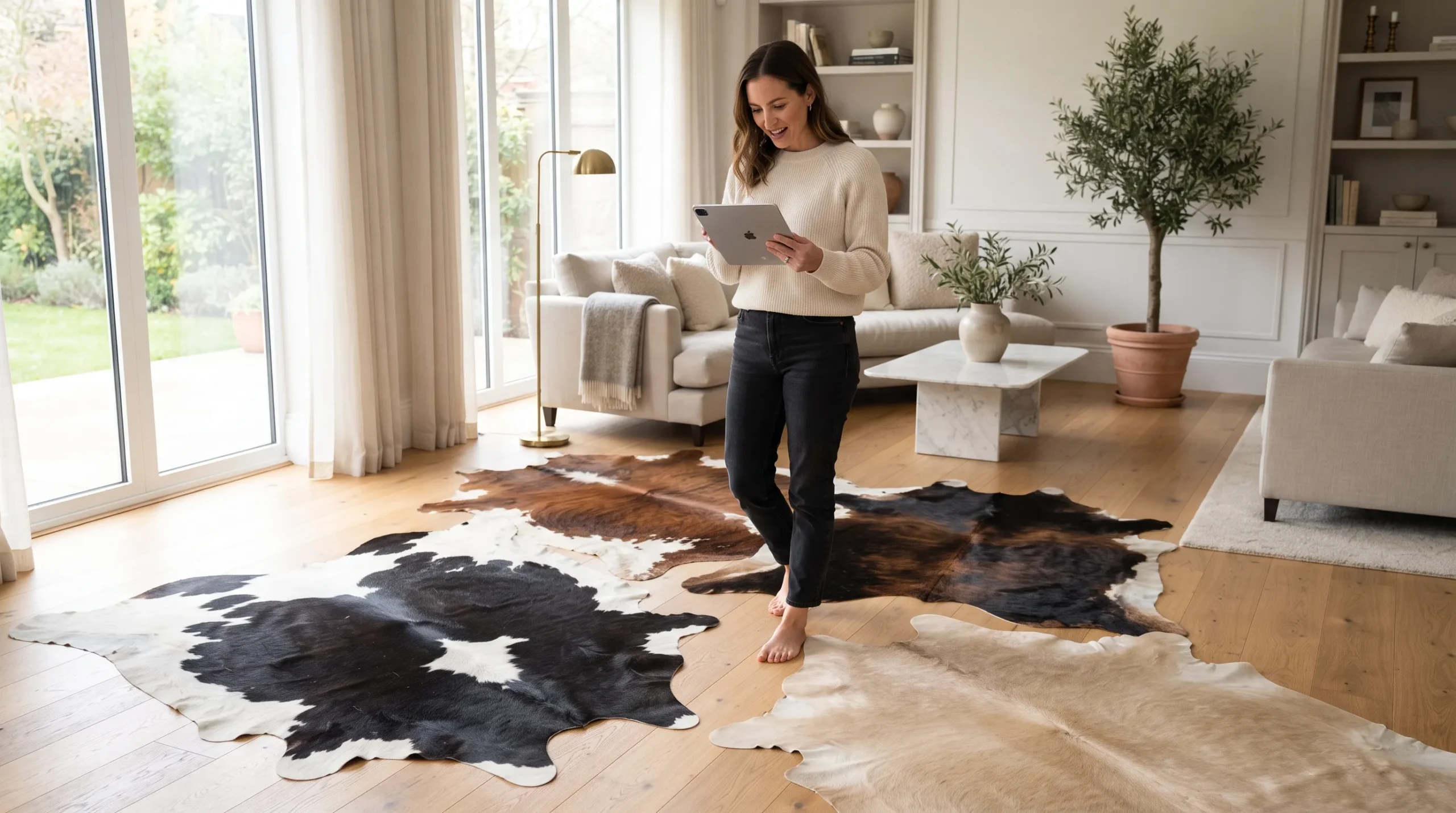
If cowhide rugs are this useful, you would think buying one would be straightforward. It is not and there are a few real reasons for that.
First, the market is full of products described as “cowhide” that are not. Synthetic rugs printed to look like hide patterns are sold alongside genuine cowhide at similar prices. Unless you know what to look for, the difference is not always obvious from a product photo.
Second, genuine cowhide rugs come in a wide range of quality levels. The tanning process, the finishing, the thickness of the hair, the way edges are trimmed all of these affect how a rug looks and how long it lasts. A poorly processed hide can smell, shed, or curl within months. A well-made one can hold up for a decade or more with basic care.
Third, cowhide rugs do not come in standard sizes the way machine-made rugs do. Each hide is shaped by the animal it came from. Knowing what size works for your specific room and understanding how to measure for an irregular shape requires a bit more thought than buying a 5×7 area rug from a catalog.
Finally, color and pattern choices matter more than people expect. What looks striking as a product image can feel overwhelming in a small room, or underwhelming in a large one. A salt-and-pepper hide reads very differently in a farmhouse than it does in a contemporary loft. Getting this right makes the difference between a rug that pulls the room together and one that just sits there.
What This Guide Covers
This guide exists to answer every real question a buyer should ask before purchasing a cowhide rug and a few questions most buyers do not think to ask until after the rug arrives.
By the time you finish reading, you will know:
- What genuine cowhide actually is and how it differs from the synthetic versions sold under similar names
- The different types of cowhide rugs brindle, tricolor, salt and pepper, patchwork, dyed, and more and which styles suit which interiors
- How to choose the right size for every room in your home, with specific measurements and furniture placement guidance
- How color and pattern interact with your existing décor across modern, farmhouse, western, rustic, and luxury design styles
- How to clean and maintain a cowhide rug so it stays in good shape for years without complicated care routines
- What separates a well-made hide from a poor one, and exactly what to look for before you buy
- Common mistakes first-time buyers make and how to avoid every one of them
- Whether cowhide rugs are a good fit for your lifestyle, including households with pets, high foot traffic, or kids
Throughout this guide, we reference Ventinots a manufacturer-direct brand that sources genuine hides, works with skilled craftsmen in Pakistan, and ships every order from its Texas warehouse. Ventinots photographs every individual hide before listing it, which means the rug you see in the product photos is the exact rug you receive. We mention them where relevant because their sourcing and photography practices reflect the standards this guide recommends buyers look for.
Whether you are buying your first cowhide rug or replacing one you have owned for years, this guide gives you everything you need to choose well, buy with confidence, and take care of what you bring home.
Let’s start with the basics.
Browse One-of-a-Kind Cowhide Rugs
What Is a Cowhide Rug?
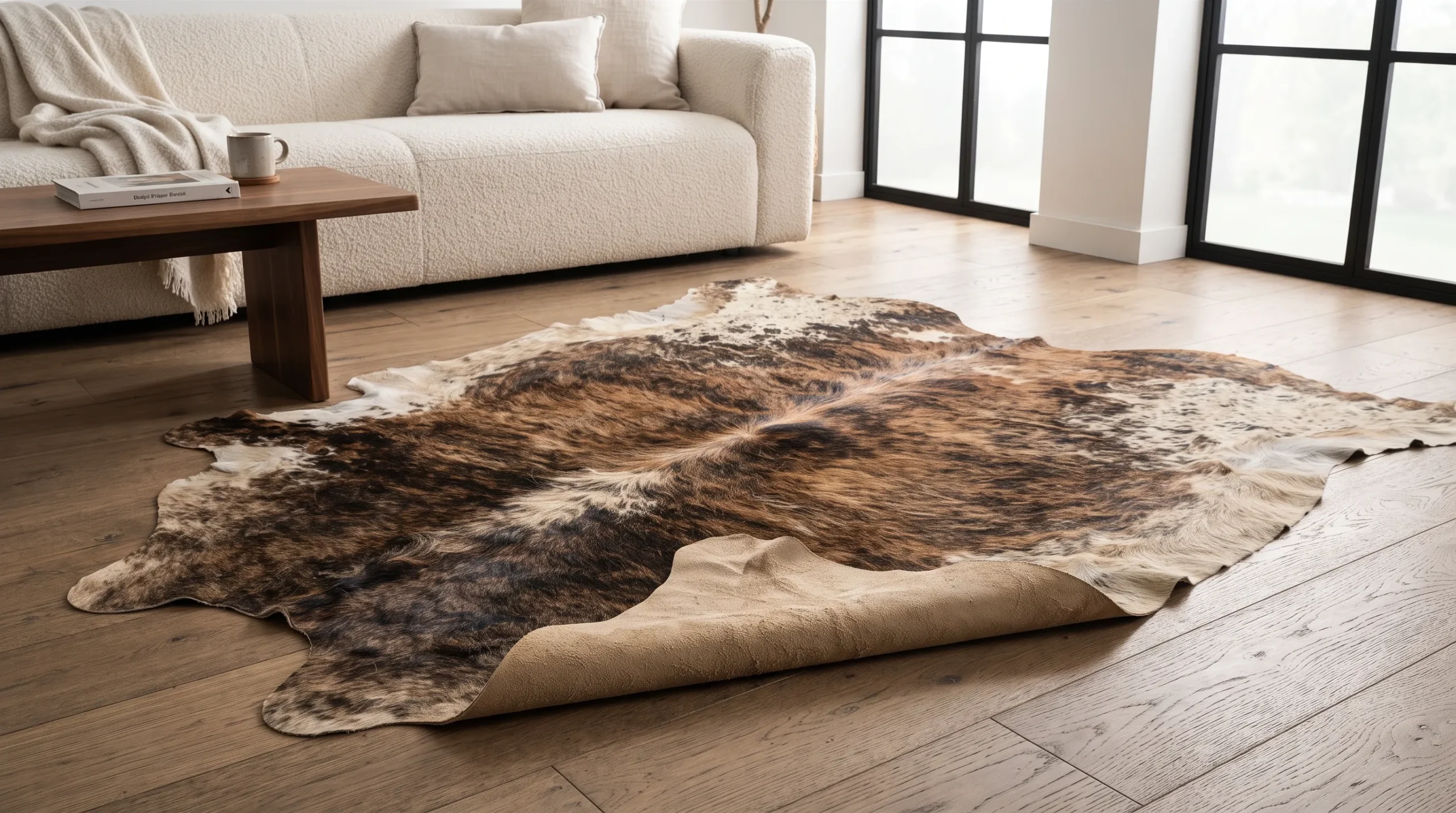
A cowhide rug is exactly what the name says: the natural hide of a cow, processed and finished for use as a floor covering or decorative piece. The hair remains intact. The shape follows the outline of the animal. The markings spots, patches, striping are entirely natural and unique to that individual hide.
No dyes are added to a natural cowhide rug. No patterns are printed. What you see is what the animal produced, preserved and prepared by skilled craftsmen so it can be used in your home for years.
That is the short answer. The longer answer how it gets from animal to finished product, and why that process matters is what this section covers.
How a Genuine Cowhide Rug Is Made
The process begins well before anyone picks up a needle or a finishing tool. It starts with hide selection. Not every hide is suitable for a rug. Craftsmen look for consistent hair coverage, clean edges, good thickness, and natural markings that will hold up through the tanning process. Hides with damage, irregular thinning, or poor hair quality are set aside.
Once selected, the hide goes through tanning the process that stabilizes the material and prevents it from decomposing. There are several methods used in the industry, but the most common for cowhide rugs is chrome tanning, which produces a soft, flexible result with good color retention. Vegetable tanning is slower and produces a stiffer material more often used for leather goods than rugs.
After tanning, the hide is dried, stretched, and trimmed. The edges are cleaned up. Any uneven sections along the natural perimeter of the hide are finished so the rug lays flat and holds its shape. The hair side is brushed and sometimes lightly treated to bring out the natural sheen.
On a well-made hide, this process produces a rug that is soft underfoot, holds its shape without curling, and smells neutral not chemical, not animal. On a poorly processed hide, you get the opposite: stiffness, curling edges, an unpleasant odor, and hair that sheds more than it should within the first few months of use.
The difference between a good cowhide rug and a bad one is almost entirely in how well each step of this process was executed.
Genuine Cowhide vs. Synthetic: What’s the Actual Difference?
This is where the market gets murky. “Cowhide rug” is a term that appears on genuine hides and synthetic imitations alike. Here is how they differ in practice:
| Feature | Genuine Cowhide Rug | Synthetic / Faux Cowhide |
| Material | Real animal hide with natural hair | Polyester, acrylic, or printed fabric |
| Pattern | Unique to each individual hide | Printed identical across units |
| Feel underfoot | Soft, dense, warm | Often flat, plasticky, or thin |
| Durability | 10–20 years with proper care | 2–5 years typical lifespan |
| Shedding | Minimal on well-tanned hides | Can pill and wear through |
| Hypoallergenic | Naturally resistant to dust mites | Varies by material |
| Smell | Neutral when properly processed | Can off-gas chemical odors initially |
| Weight | Heavier, stays in place | Lighter, more likely to shift |
| Price | Higher upfront cost | Lower entry price |
Synthetic rugs are not always obvious to the eye in a product photo. In person, the difference is usually clear within seconds: the weight, the feel of the hair, and the texture of the backing all give it away. Online, the clearest signal is whether the seller shows you the exact hide or a generic representative image. Genuine cowhide sellers who photograph individual hides have nothing to hide. Sellers using stock imagery often do.
Why Every Genuine Cowhide Rug Is Unique
This is one of the things buyers either love immediately or need a moment to appreciate: no two genuine cowhide rugs are identical.
The spot pattern on a tricolor hide belongs to one animal. The density of markings on a salt-and-pepper rug reflects how that specific cow developed its coat. The way brindle striping runs across a hide its width, its intensity, where it concentrates cannot be replicated because there is no template for it. It came from a living thing.
This means when you order a genuine cowhide rug, you are not receiving a unit from a batch. You are receiving a specific piece. Some sellers acknowledge this by photographing every individual hide before listing it so the rug in the product photos is literally the rug being shipped to you, not a similar one. This practice matters more than most buyers realize until they have ordered from a seller who does not do it.
Common Myths About Cowhide Rugs
Myth: Cowhide rugs smell bad.
A well-tanned, properly processed cowhide rug has no unpleasant odor. If a new rug smells strongly of chemicals or animal, that is a sign of poor processing not something inherent to cowhide as a material.
Myth: They shed constantly.
Genuine cowhide rugs shed very little compared to wool or shag rugs. High shedding on a cowhide is almost always a quality issue: either the tanning was inadequate or the hair was poorly anchored during finishing.
Myth: They are hard to clean.
Cowhide is one of the easier natural floor coverings to maintain. Spills wipe off the hair surface rather than absorbing into fibers. Regular shaking and occasional vacuuming on low suction handle most of the upkeep.
Myth: They only work in western or rustic rooms.
Cowhide rugs have appeared in Scandinavian-minimalist spaces, contemporary lofts, mid-century modern living rooms, and coastal interiors. The material is versatile enough that the style of the room shapes the look of the rug, not the other way around.
Are Cowhide Rugs Ethical?
This is a fair question, and it deserves a direct answer.
Genuine cowhide rugs are a by-product of the beef industry. The hides used to make cowhide rugs would otherwise be discarded during the meat production process. Using them as rugs reduces waste rather than creating it.
This is different from materials sourced specifically for the skin cowhide rugs are not driving additional animal use. For buyers concerned about the ethics of animal products, the by-product distinction is a meaningful one.
Synthetic alternatives, by contrast, are typically made from petroleum-based materials that do not biodegrade and require significant energy to produce. Whether genuine cowhide or synthetic is the more responsible choice depends on what environmental factors the buyer prioritizes but the idea that synthetic is automatically the more ethical option does not hold up to scrutiny.
Benefits of Cowhide Rugs
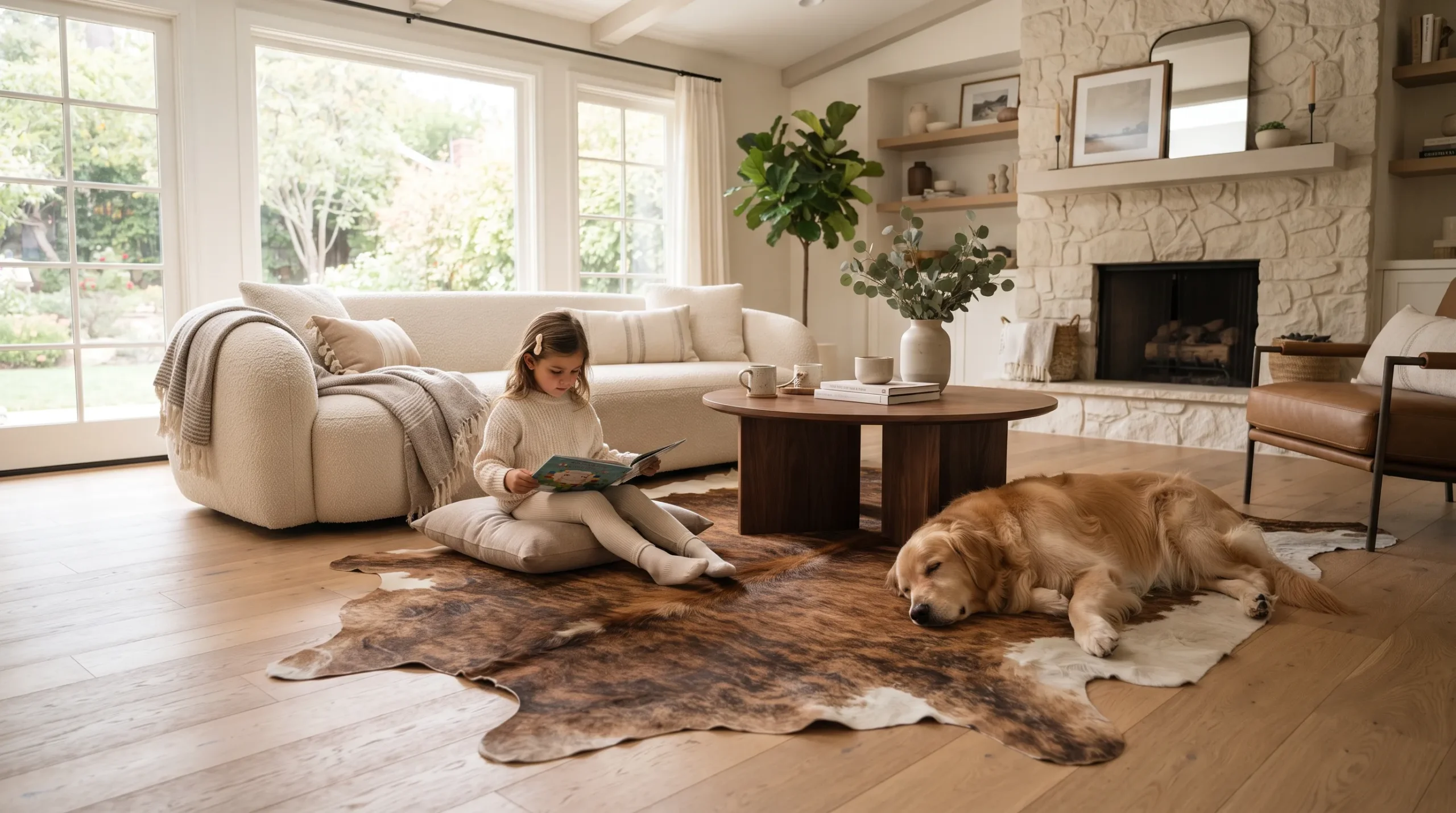
Most people start looking at cowhide rugs because they like the way they look. They keep them because of how they perform.
A genuine cowhide rug is not a decorative piece you have to protect or replace every few years. It is a functional floor covering that holds up under real daily use foot traffic, pets, kids, furniture weight while continuing to look good. That combination is rarer than it sounds in the home décor market.
Here is what genuine cowhide actually delivers, beyond the aesthetics.
1. Durability That Outlasts Most Alternatives
Cowhide is dense, tightly structured material. The hair is short and firmly anchored. The backing is the hide itself not a woven fabric or synthetic base that can separate or wear through.
A well-made genuine cowhide rug, with basic care, lasts 10 to 20 years. That is not a marketing claim. It is the natural outcome of using a material that evolved to handle outdoor exposure and physical stress, then processed by craftsmen who know how to stabilize and finish it properly.
Compare that to a wool area rug, which typically shows visible wear in high-traffic areas within three to five years. Or a synthetic rug, where the printed pattern begins to fade and the backing starts to deteriorate in a similar timeframe. Cowhide does not fade the way printed materials do. The natural markings are in the hair itself they do not wash out or wear off.
2. Easier Maintenance Than Most Natural Rugs
If you have ever owned a wool, jute, or shag rug, you know the maintenance burden that comes with it. Spills soak into the fibers. Pet hair gets buried in the pile. Vacuuming on the wrong setting pulls fibers loose. Deep cleaning requires professional equipment or sending the rug out entirely.
Cowhide works differently. Liquids sit on the surface of the hair rather than immediately absorbing. That gives you time to blot a spill before it becomes a stain. Day-to-day upkeep is straightforward: shake it out periodically, vacuum on low suction in the direction of the hair, and wipe surface spills with a damp cloth.
Real example: A family with two kids uses a tricolor cowhide in their living room under a coffee table. A juice spill that would have left a permanent mark on a wool rug was blotted off the cowhide in under a minute with a dry cloth. Six months in, the rug looks the same as the day it arrived.
That ease of care is not an accident. The natural structure of cowhide resists absorption in a way that woven textiles simply cannot replicate.
3. Naturally Hypoallergenic
This surprises many buyers. Wool rugs, despite their natural origins, can trap dust mites, allergens, and pet dander deep in their fibers exactly where a vacuum cannot reach them easily. The dense pile creates a habitat for microscopic particles that trigger allergic reactions.
Cowhide does not have this problem. The short, smooth hair does not trap particles the way long-pile textiles do. Dust settles on the surface, where regular shaking or vacuuming removes it. There is no deep pile for allergens to hide in.
For households with allergy sufferers, this is a meaningful practical advantage not a marketing talking point. Interior designers frequently specify cowhide rugs for clients who love the warmth of natural materials but cannot tolerate the allergen load that comes with traditional wool or synthetic pile rugs.
4. Resistance to Shedding and Wear
Shedding is one of the most common complaints about natural rugs. Wool rugs shed. Jute rugs shed. Even well-made shag rugs lose fibers over time.
A properly tanned cowhide rug sheds minimally and what little shedding occurs in the first few weeks after unboxing typically stops once the rug settles into its environment. The hair is anchored at the hide level, not woven into a backing that loosens with foot traffic.
It also resists the kind of compression wear that flattens pile rugs over time. Heavy furniture placed on a cowhide rug does not leave the same permanent indentations it creates in a wool or synthetic pile. The dense, flat structure of the hair layer bounces back more reliably.
5. Ideal for High-Traffic Areas
Most rugs placed under coffee tables, in entryways, or at the foot of beds show visible wear within a year or two. The paths where feet fall repeatedly create worn channels that no amount of rotation fully prevents.
Cowhide handles high-traffic placement better than almost any textile rug at a comparable price point. The material does not thin or compress the same way. An entryway cowhide rug that greets hundreds of footsteps per week holds its appearance significantly longer than a comparable wool or synthetic piece would.
Real example: A boutique hotel in Austin placed brindle cowhide rugs in six guest rooms. Three years and several thousand guest stays later, the rugs required nothing more than routine cleaning. The same hotel had replaced its wool corridor runners twice in the same period.
6. Timeless Style That Does Not Go Out of Fashion
Trends in home décor cycle fast. A rug that looks current today can feel dated in two to three years. Cowhide has avoided this problem for decades because its appeal is not tied to a trend it is tied to natural material.
Natural markings do not look retro. They do not look dated. A well-chosen cowhide rug looks as relevant in a room redesigned five years from now as it does today.
This matters economically as much as aesthetically. When you spend meaningfully on a floor covering, you want it to survive not just physically but stylistically. Cowhide has a track record of doing both.
7. Versatility Across Interior Styles
Few materials work as naturally across as many design contexts as genuine cowhide.
- Modern and contemporary rooms: A black-and-white cowhide under a low-profile sectional adds organic contrast without competing with clean architectural lines.
- Farmhouse interiors: A tricolor or brown-and-white hide grounds a shiplap-and-linen room with texture and warmth.
- Western and ranch-style homes: Brindle and salt-and-pepper hides feel native to the aesthetic without requiring any styling effort.
- Luxury spaces: A large, well-marked natural hide on polished concrete or wide-plank oak reads as deliberately curated the kind of piece that looks expensive because it is genuinely rare.
- Scandinavian and minimalist rooms: A single clean cowhide on a white oak floor adds the one layer of warmth these interiors need without cluttering them.
Ventinots’ collection spans all of these use cases natural hides, dyed options and patchwork formats with every piece individually photographed so buyers can evaluate exactly how a specific hide will read in their space before purchasing.
7 Reasons Cowhide Rugs Are the Best Choice
Types of Cowhide Rugs
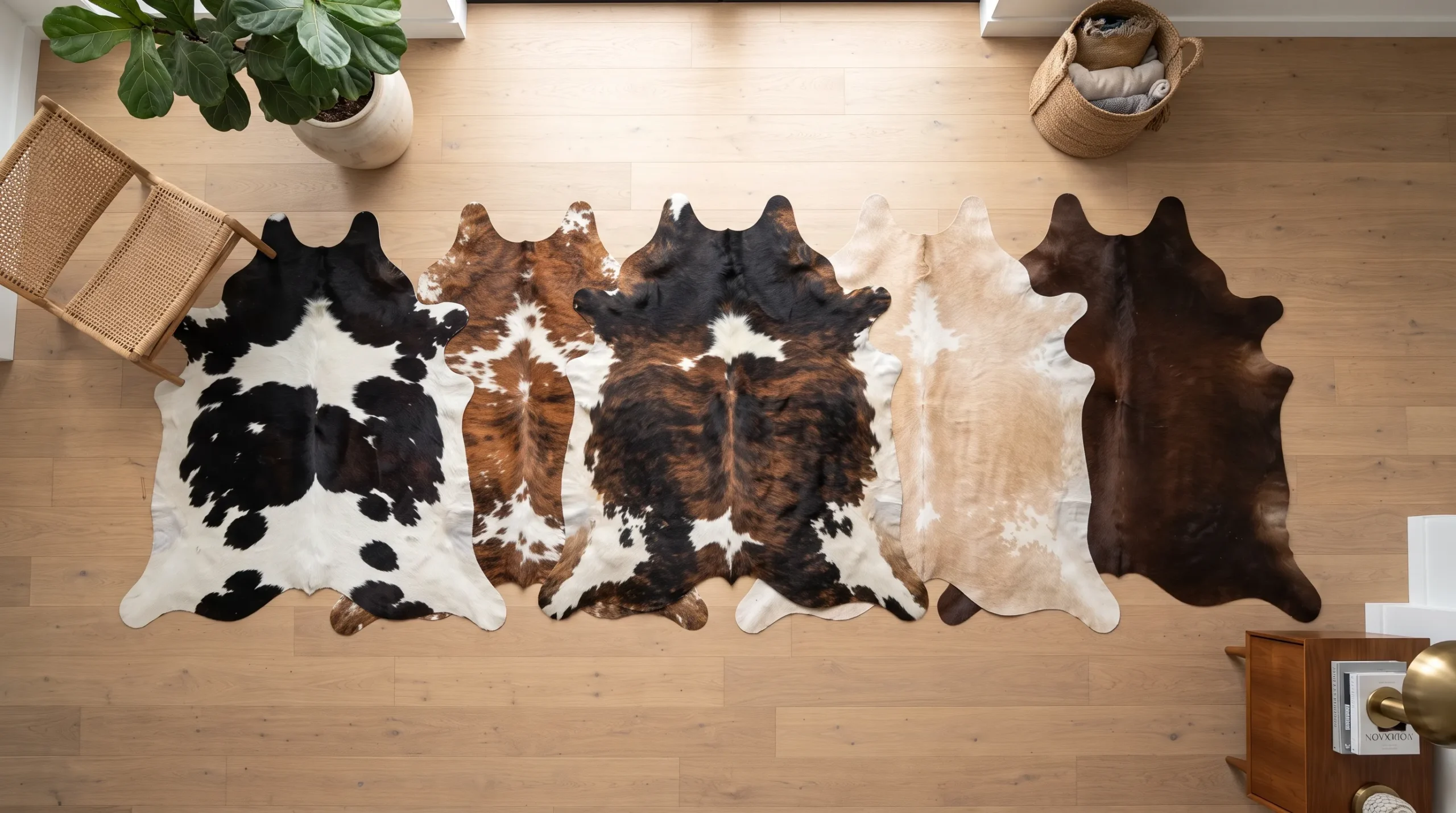
Walk into any well-stocked cowhide rug collection and the variety can stop you in your tracks. Brindle. Tricolor. Salt and pepper. Patchwork. Dyed. Metallic. Each one looks different, performs differently and suits different rooms and design styles.
Understanding the types before you shop saves time, prevents mismatches and helps you zero in on the right hide for your space without second-guessing every option.
Here is every major cowhide rug style explained what it looks like, where it works best and what to consider before buying.
1. Brindle Cowhide Rugs
Appearance: Brindle hides feature irregular streaking and striping typically a mix of brown, tan, and black that runs across the hide in natural, unpredictable directions. No two brindle hides have the same pattern density or stripe distribution. The overall effect is warm, textured, and organic.
Best décor styles: Farmhouse, rustic, western, transitional, casual contemporary.
Best room placements: Living rooms, bedrooms, home offices, cabin interiors.
Pros:
- Warm, natural tones blend easily with wood furniture and earthy palettes
- The striping adds visual interest without reading as busy
- Highly versatile across a wide range of interior styles
Cons:
- The varied pattern can be harder to evaluate from a product photo individual photography matters more here than with simpler hides
- May not suit very minimalist or monochrome interiors where a cleaner pattern is preferred
Brindle is one of the most popular choices for buyers who want a natural cowhide look without the stark contrast of a black-and-white hide.
2. Tricolor Cowhide Rugs
Appearance: Tricolor hides combine three distinct tones most commonly black, white, and brown in large, clearly defined patches. The distribution of patches varies dramatically from hide to hide. Some tricolors are predominantly white with dark patches; others are roughly balanced across all three tones.
Best décor styles: Western, ranch-style, traditional, eclectic, bold contemporary.
Best room placements: Living rooms under coffee tables, dining rooms, entryways, statement bedroom placements.
Pros:
- High contrast and visual impact these hides make a statement
- The natural patch distribution gives each piece genuine uniqueness
- Works well as a focal point in rooms with otherwise neutral furnishings
Cons:
- The boldness can overwhelm smaller rooms
- Requires more care in color coordination with existing furniture
If you want a cowhide rug that commands attention, tricolor is the category to look at first.
3. Salt and Pepper Cowhide Rugs
Appearance: Salt and pepper hides are characterized by a dense, fine mix of black and white hairs distributed evenly across the hide no large patches, no defined stripes. The overall effect reads as a soft, cool gray when viewed from a distance, with visible texture up close.
Best décor styles: Modern, Scandinavian, minimalist, contemporary, industrial.
Best room placements: Home offices, modern living rooms, bedrooms with neutral palettes, urban loft spaces.
Pros:
- The most versatile cowhide pattern for modern and minimalist interiors
- Reads as neutral from a distance, allowing other décor elements to take center stage
- Works in rooms where a bolder hide pattern would compete with existing design choices
Cons:
- Less visual drama than tricolor or brindle options
- The subtlety that makes it versatile also makes it easier to overlook in a bold, layered room
Salt and pepper hides are the go-to choice for interior designers working in contemporary spaces who want the material without the pattern becoming the centerpiece.
4. Black and White Cowhide Rugs
Appearance: High-contrast patches of solid black and clean white, with clearly defined edges between colors. The pattern varies some hides are predominantly white with black patches, others lean heavily dark. The contrast is sharper and more graphic than a salt-and-pepper or brindle hide.
Best décor styles: Contemporary, mid-century modern, bold minimalist, monochrome interiors.
Best room placements: Living rooms, bedrooms, under dining tables, home offices with strong graphic design elements.
Pros:
- The strongest graphic impact of any natural cowhide pattern
- Works exceptionally well in black-and-white or monochrome interior schemes
- Photographs beautifully a strong choice for spaces that get photographed often
Cons:
- The contrast can feel stark in warm-toned or earthy rooms
- Requires thoughtful furniture placement to avoid looking heavy
Black-and-white cowhide rugs are among the most searched and most purchased and for good reason. When the room is right for them, nothing else achieves the same visual clarity.
5. Brown and White Cowhide Rugs
Appearance: Similar in structure to black-and-white hides but warmer in tone. Brown patches range from light tan to deep chocolate depending on the individual animal, combined with white or cream areas.
Best décor styles: Farmhouse, traditional, transitional, warm contemporary, coastal.
Best room placements: Bedrooms, living rooms with warm wood furniture, dining rooms, entryways.
Pros:
- Warmer than black-and-white hides easier to incorporate into rooms with earthy or wood-heavy palettes
- The variation in brown tones means each hide has genuine depth
- Works naturally alongside leather furniture and wooden accents
Cons:
- Less graphic impact than black-and-white better suited to rooms where the rug plays a supporting role rather than a starring one
Brown-and-white hides are one of the best starting points for first-time cowhide buyers because they integrate into existing rooms more forgivingly than higher-contrast options.
6. Dyed Cowhide Rugs
Appearance: Genuine cowhide hides hand-dyed in solid or tonal colors deep blues, vivid reds, forest greens, rich burgundy, and more. Crucially, the natural spot and patch markings remain visible through the dye, giving the rug depth that no printed synthetic can replicate.
Best décor styles: Eclectic, bohemian, maximalist, contemporary, accent-focused rooms.
Best room placements: Living rooms as statement pieces, bedrooms as color anchors, offices needing a bold design element.
Pros:
- Introduces bold color while retaining the natural texture and uniqueness of real cowhide
- The visible natural markings through the dye make the piece genuinely one of a kind
- Allows buyers who love the material to work with a broader color palette
Cons:
- Color intensity can vary slightly between hides individual photography matters more here
- Not suited to rooms where the color scheme is already saturated
Ventinots’ dyed cowhide rug range includes colors that are underrepresented in the wider market a meaningful option for buyers who want something genuinely different.
7. Patchwork Cowhide Rugs
Appearance: Multiple individual hides cut into shapes and stitched together by hand into a larger piece available in both rectangular and round formats. The result is a mosaic of textures, tones, and patterns from different animals, combined into a single cohesive rug.
Best décor styles: Bohemian, eclectic, maximalist, rustic, transitional.
Best room placements: Large living rooms, dining rooms, master bedrooms, any space that needs a large-format natural rug with strong visual texture.
Pros:
- Available in larger sizes than single hides suitable for open-plan spaces
- The combination of multiple hides creates visual complexity that a single hide cannot
- Round formats work especially well under round dining tables or in circular seating arrangements
Cons:
- Stitching quality is critical poor seam work will separate under foot traffic
- More complex to evaluate online; buy only from sellers who show close-up stitching details
8. Brazilian Cowhide Rugs
Appearance: Not a pattern category but an origin designation. Brazilian cowhide rugs are specifically sourced from cattle raised in Brazil and are widely regarded as some of the highest-quality hides available, known for their dense, lustrous hair and clean markings.
Best décor styles: Any the quality distinction is about material grade, not pattern type.
Pros:
- Dense, high-quality hair with strong natural sheen
- Generally considered a premium grade within the cowhide market
- Consistent tanning standards from established Brazilian processing facilities
Cons:
- Higher price point than hides from other origins
- “Brazilian cowhide” is sometimes used as a marketing label without verification look for sellers who are transparent about sourcing
Quick Comparison: Cowhide Rug Types at a Glance
| Type | Visual Impact | Best For | Versatility |
| Brindle | Medium-high | Farmhouse, rustic, transitional | High |
| Tricolor | High | Western, bold contemporary | Medium |
| Salt & Pepper | Low-medium | Modern, minimalist, Scandinavian | Very High |
| Black & White | Very High | Contemporary, monochrome | Medium |
| Brown & White | Medium | Farmhouse, traditional, warm interiors | High |
| Dyed | High | Eclectic, bohemian, color-forward rooms | Medium |
| Patchwork | Very High | Large spaces, eclectic, maximalist | Medium |
| Brazilian | Varies | Any premium quality grade | Very High |
Choosing the Right Cowhide Rug Size
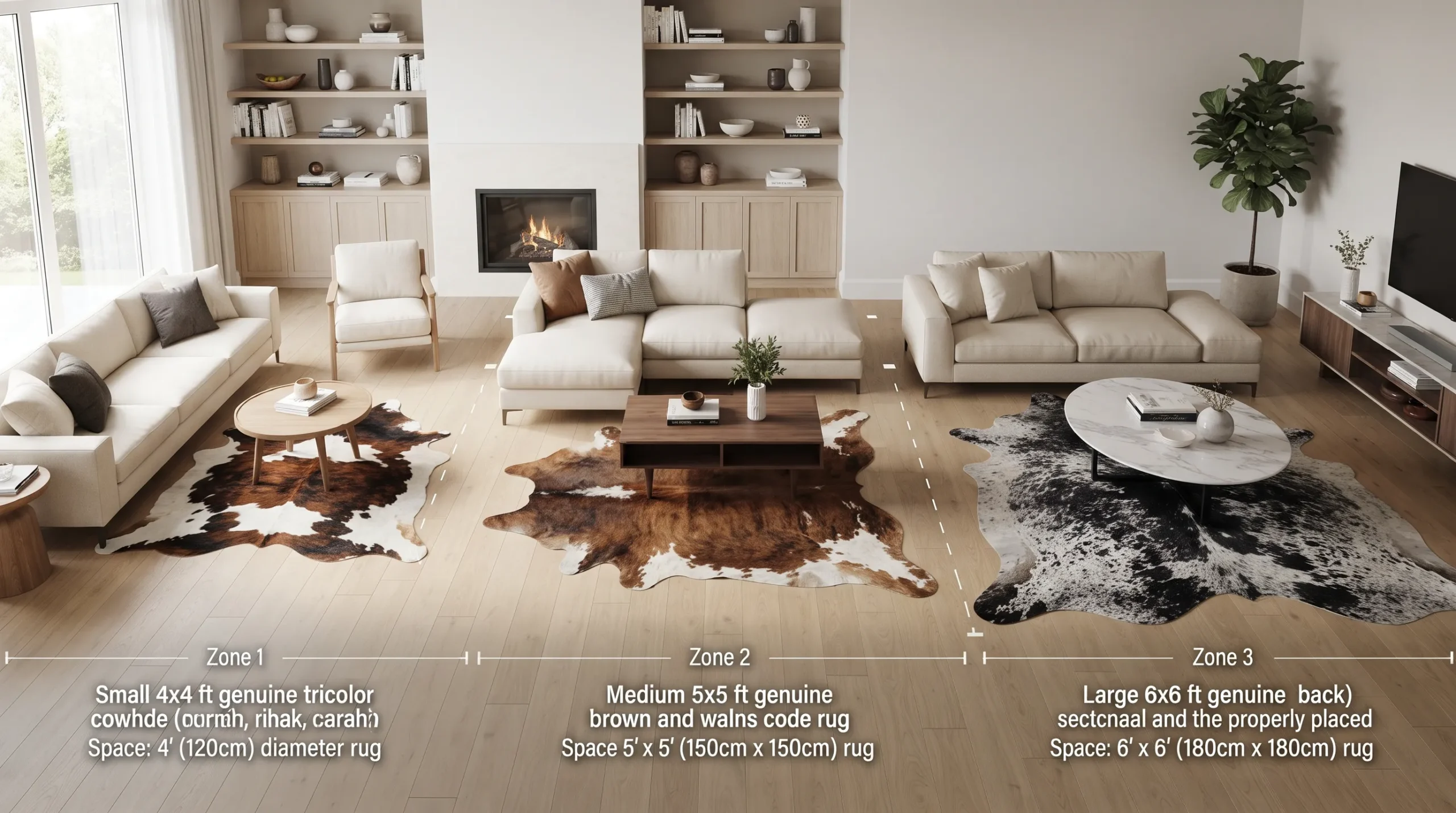
Size is the most common mistake first-time cowhide rug buyers make. Not color. Not pattern. Size.
A rug that is too small makes a room feel unfinished like the furniture is floating on bare floor with a small mat tucked underneath. A rug that is too large crowds the space and eliminates the breathing room that makes a room feel designed rather than cluttered.
The challenge with cowhide rugs is that they do not follow standard sizing conventions. A traditional area rug comes in predictable dimensions: 5×8, 8×10, 9×12. You find the size that fits your room and order it. Cowhide rugs come in the shape and size of the animal they came from. An Medium (M) hide might measure around 4×4 feet. An Extra Large (XL) hide might run around 6×6 feet, but with a shape that is wider at one end than the other.
That irregularity is part of what makes genuine cowhide beautiful. It also requires a different approach to sizing than most buyers are used to.
Here is how to get it right, room by room.
Understanding Cowhide Rug Sizes
Ventinots cowhide rugs are sold in three size classifications:
- Medium (M): Roughly 4×4 feet (around 20 sq ft)
- Large (L): Roughly 5×5 feet (around 30 sq ft)
- Extra Large (XL): Roughly 6×6 feet (around 40 sq ft)
Because each hide follows the natural outline of the animal, the listed dimensions reflect the longest and widest points of the hide not a uniform rectangle. An Extra Large (XL) hide listed at roughly 6×6 feet may be narrower at the top and wider at the bottom, following the natural shape of the animal.
This matters when you are measuring for a specific placement. Always measure the actual floor space you want the rug to cover, then compare it against the size classification that comfortably covers that space. You have more flexibility with cowhide than with a rectangular rug the organic edges often look better extending past furniture legs rather than stopping short of them.
Living Room Cowhide Rug Size Guide
The living room is where most cowhide rugs end up, and where most sizing mistakes happen.
The most common mistake: Choosing a rug that fits only under the coffee table, leaving sofa legs on bare floor. This makes even a beautiful hide look like an afterthought.
The right approach: For a standard sofa-and-chairs seating arrangement, aim for a hide large enough that at least the front two legs of every major seating piece rest on the rug. This anchors the furniture grouping visually and prevents the rug from looking undersized.
| Room Size | Recommended Hide Size |
| Small living room (under 200 sq ft) | Medium (M) hide, roughly 4×4 ft |
| Standard living room (200–300 sq ft) | Large (L) hide, roughly 5×5 ft |
| Large or open-plan living room | Extra Large (XL) hide, roughly 6×6 ft |
| Accent placement (beside sofa or chair) | Medium (M) hide, roughly 4×4 ft |
Furniture placement tip: In a living room with a sectional sofa or a large open-plan seating area, a single Extra Large (XL) hide may not fully cover the seating zone the way a larger rectangular rug would. In these cases, consider positioning the Extra Large (XL) hide as an anchor piece under the main seating cluster, or pairing it with a second hide or a patchwork cowhide rug for full coverage. In a room with a three-seat sofa and two accent chairs, an Extra Large (XL) hide with all front legs resting on the rug creates a well-proportioned look.
Bedroom Cowhide Rug Size Guide
In a bedroom, the rug’s relationship to the bed determines everything.
The goal is to have enough rug extending beyond the sides and foot of the bed that the first thing your feet touch in the morning is the hide not cold hardwood or tile.
Standard placement rules:
- King bed: An Extra Large (XL) hide (roughly 6×6 ft) works best positioned at the foot of the bed or along one side, rather than centered under the entire bed, since a single hide at this size will not extend on all sides the way a larger rectangular rug would. For full coverage around a king bed, consider two hides or a patchwork cowhide rug.
- Queen bed: An Large (L) hide (roughly 5×5 ft) works well at the foot of the bed or along one side, using the same principle as above.
- Twin or full bed: An Medium (M) hide (roughly 4×4 ft) works well if positioned to extend evenly on both sides and the foot.
Alternative placements in the bedroom: A cowhide does not have to go under the bed. A smaller hide at the foot of the bed, or an Medium (M) hide in a reading corner beside an armchair, can work just as well in a bedroom where the floor space does not suit a full under-bed placement.
Dining Room Cowhide Rug Size Guide
Dining room rug placement has one non-negotiable rule: the rug must be large enough that dining chairs remain on the rug when pulled out from the table.
If chairs slide off the rug edge every time someone sits down or stands up, the rug is too small. This is not just aesthetically problematic chair legs catching the edge of a rug repeatedly will cause it to shift, curl, and wear at the edges faster than normal.
The formula: Measure your dining table, then add at least 24 inches on every side to account for chair movement.
| Table Size | Recommended Hide Size |
| Small table (4 seats) | Extra Large (XL) hide, roughly 6×6 ft, or a patchwork cowhide rug for full coverage |
| Standard table (6 seats) | Patchwork cowhide rug recommended for full coverage |
| Large table (8+ seats) | Patchwork cowhide rug, larger rectangular formats |
Note on shape: Because a single hide tops out at roughly 6×6 feet, most dining tables will need a patchwork cowhide rug to keep chairs on the rug when pulled out. Patchwork rugs are stitched from multiple hides into larger rectangular formats that suit table placement better than a single hide’s irregular organic shape.
Home Office Cowhide Rug Size Guide
Home offices benefit from a rug that defines the desk and chair zone without overwhelming the rest of the room.
An Medium (M) hide (roughly 4×4 ft) works well in most office configurations. Position it so that the desk sits on the rug and the chair remains on the rug when rolled back to a natural working distance from the desk.
If the office doubles as a sitting room or meeting space, size up to an Large (L) or Extra Large (XL) hide and treat it the same way you would a living room placement: front legs of all seating on the rug.
Entryway Cowhide Rug Size Guide
Entryways are where smaller hides earn their place. An Medium (M) cowhide (roughly 4×4 ft) in an entryway creates an immediate first impression without crowding a transitional space.
The practical benefit here is meaningful: cowhide handles the dirt and foot traffic of an entryway better than almost any textile rug. It wipes clean. It does not absorb moisture the way wool does. A cowhide in an entryway is a practical choice dressed in a premium material.
Sizing tip for entryways: The rug should be wide enough that two people standing side by side in the entry are both on the rug. Length matters less than width in most entryway configurations. For wider entryways, an Large (L) hide gives more room to work with.
Hallway Cowhide Rug Ideas
Hallways present the one scenario where a single cowhide hide is rarely the right answer. Standard hides are too wide for most hallway widths and not long enough to run the length of a typical corridor.
Better options for hallways:
- A series of Medium (M) hides laid end to end with slight gaps between them this can look deliberately styled rather than improvised
- A patchwork cowhide runner cut or stitched to a narrower width
- A single Medium (M) hide placed at a specific point in the hallway at the entrance to a room, or at the end of a corridor as an accent rather than a full runner
Common Cowhide Rug Sizing Mistakes
Measuring only the furniture, not the room. A rug that fits the furniture can still be wrong for the space if the room itself is large. Always consider the room dimensions alongside the furniture footprint.
Forgetting to account for irregular shape. An Extra Large (XL) hide listed at roughly 6×6 feet is not a rectangle. The widest and longest measurements are the outer boundaries of an organic outline. The actual coverage in a rectangular zone will be somewhat less than those dimensions suggest.
Buying too small to save money. An undersized rug costs as much as a correctly sized one and makes the room look worse. If a single hide is not large enough for the space, consider a patchwork option they are available in larger formats and often at comparable price points.
Ignoring the nap direction. Cowhide hair has a natural direction. In a living room, the hair should run away from the main seating area toward the far wall so it lays naturally under foot traffic rather than against it.
Quick Cowhide Rug Size Recommendation Chart
| Room / Use | Recommended Size |
| Small living room (under 200 sq ft) | Medium (M) (4×4 ft) |
| Standard living room (200–300 sq ft) | Large (L) (5×5 ft) |
| Large or open-plan living room | Extra Large (XL) (6×6 ft) |
| Accent placement (sofa or chair) | Medium (M) (4×4 ft) |
| King bed | Extra Large (XL) (6×6 ft), foot or side placement |
| Queen bed | Large (L) (5×5 ft), foot or side placement |
| Twin or full bed | Medium (M) (4×4 ft) |
| Dining table, 4 seats | Extra Large (XL) (6×6 ft) or patchwork |
| Dining table, 6 seats | Patchwork cowhide rug |
| Dining table, 8+ seats | Patchwork cowhide rug |
| Home office | Medium (M) (4×4 ft) |
| Home office / meeting space | Large (L) or Extra Large (XL) |
| Entryway | Medium (M) (4×4 ft) |
| Wider entryway | Large (L) (5×5 ft) |
| Hallway | Multiple Medium (M) hides or patchwork runner |
Choosing the Right Cowhide Rug Color
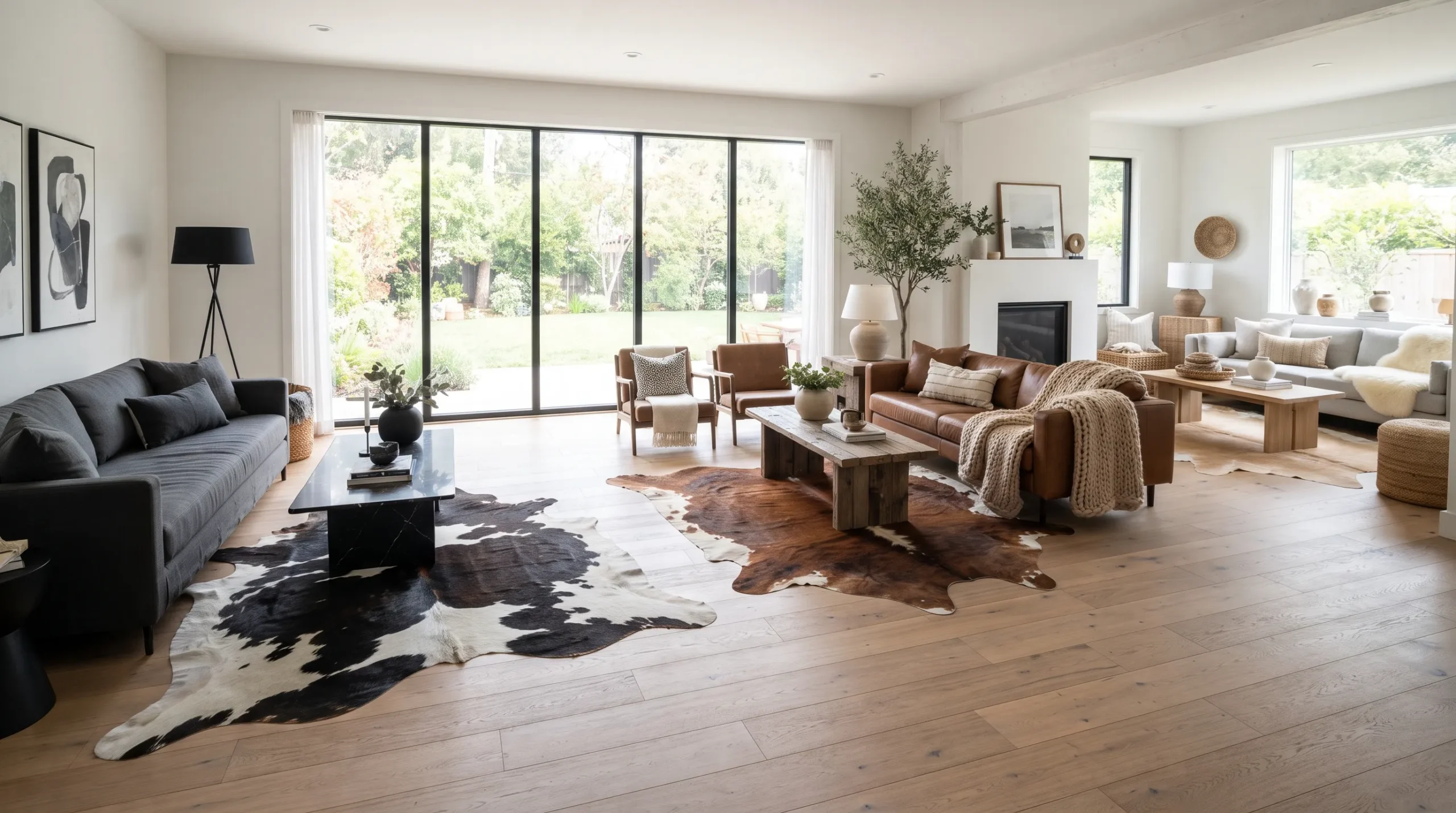
Pattern gets most of the attention when people shop for cowhide rugs. Color does most of the work.
The right color ties a room together. The wrong one even on a beautifully marked, well-made hide creates visual friction that no amount of styling will fix. A brindle rug in warm tones that would look at home in a rustic farmhouse can feel muddy and heavy in a cool-toned Scandinavian room. A clean black-and-white hide that elevates a contemporary loft can feel stark and cold in a cabin with warm wood walls.
Color selection is not complicated, but it requires a few minutes of honest assessment before you buy. This section walks you through exactly how different cowhide colors interact with the most common interior design styles so you choose with confidence rather than guessing.
Start with the Room, Not the Rug
The most reliable approach to cowhide color selection is to build outward from what you already have rather than starting with the rug and trying to make the room conform to it.
Ask three questions before you look at a single hide:
1. What is the dominant tone of the room?
Warm rooms lean on amber, honey, rust, terracotta, caramel and cream. Cool rooms pull toward gray, white, slate, navy and sage. Neutral rooms sit between both. Your cowhide should complement the dominant tone not fight it.
2. What materials are already in the room?
Wood-heavy rooms with oak, walnut, or pine furniture read warmer and benefit from hides with brown, tan, or brindle tones. Rooms with metal, glass, or painted white furniture read cooler and suit salt-and-pepper, black-and-white, or dyed hides better.
3. What role do you want the rug to play?
Some buyers want the rug to anchor the room quietly a foundation piece that ties the furniture together without drawing attention to itself. Others want it to be the first thing guests notice. These two goals call for very different color choices.
With those answers in mind, here is how each cowhide color category performs across the most common interior styles.
Best Cowhide Rug Colors for Modern and Contemporary Interiors
Modern rooms are built on restraint. Clean lines, limited color palette, deliberate material choices. A rug in this context needs to add warmth and texture without cluttering the visual field.
Best Color Choices
- Salt and pepper: The most popular choice for modern interiors. The fine mix of black and white reads as a soft neutral from across the room while providing close-up texture. It does not compete with furniture or architectural details.
- Black and white: Works well in rooms with strong graphic design elements particularly spaces with black metal fixtures, white walls, and dark wood furniture. The contrast is intentional, not accidental.
Colors to Avoid
Heavy tricolor or brindle hides in rooms with minimal furniture and little existing warmth they can read as visually loud against clean modern backdrops.
Best Cowhide Rug Colors for Farmhouse Interiors
Farmhouse design is built on natural materials, soft neutrals, and a studied sense of casual comfort. Cowhide integrates into this aesthetic more naturally than almost any other rug type.
Best Color Choices
- Brown and white: The warmest and most forgiving cowhide color combination for farmhouse rooms. It echoes the natural palette of shiplap walls, linen upholstery, and raw wood furniture without adding visual weight.
- Brindle: The irregular warm striping of a brindle hide suits the layered, organic character of farmhouse interiors. It works particularly well alongside woven baskets, rattan furniture, and cotton textiles.
- Tricolor: Works in farmhouse rooms that lean slightly western or rustic the bold patches add energy without disrupting the natural material palette.
Colors to Avoid
- Dyed hides in saturated colors they tend to sit at odds with the muted, sun-bleached quality that defines well-executed farmhouse design.
Best Cowhide Rug Colors for Rustic and Cabin Interiors
Rustic rooms are defined by raw materials: exposed beam ceilings, stone fireplaces, reclaimed wood floors, leather sofas and iron fixtures. Cowhide is native to this environment.
Best Color Choices
- Brindle: The natural warmth and irregular patterning of brindle hides mirrors the organic unpredictability of reclaimed wood and rough-hewn stone. Few rugs feel as at home in a cabin setting.
- Tricolor: Bold enough to hold its own against the heavy visual weight of stone, timber, and dark leather. A well-marked tricolor under a coffee table in a cabin living room is one of the strongest design moves available at this price point.
- Brown and white: For rooms where the other materials are already visually busy, brown and white provides natural cowhide character with a slightly calmer visual presence.
Colors to Avoid
- Salt-and-pepper or cool-toned hides they can feel mismatched against the warmth of most rustic palettes.
Best Cowhide Rug Colors for Luxury Interiors
Luxury interiors are defined less by a specific palette than by quality of material and intentionality of selection. Cowhide works here because a genuinely well-marked, correctly sized hide signals the same design sensibility as other premium natural materials: marble, aged brass, cashmere, solid walnut.
Best Color Choices
- Large natural hides with exceptional marking: In a luxury interior, the hide itself is the statement. A flawlessly marked extra-large brindle or tricolor on polished concrete or wide-plank European oak reads as deliberately curated.
- Dyed cowhide in deep, rich tones: A navy or burgundy dyed cowhide with visible natural markings showing through the color sits comfortably alongside velvet upholstery, brass fixtures, and lacquered furniture. It adds color depth that no synthetic rug can replicate.
- Patchwork in neutral combinations: A large patchwork rug composed of salt-and-pepper and white hides in a rectangular format can serve a luxury dining room or great room in the way an antique kilim might as a piece with clear material provenance and visible craft.
Colors to Avoid
- Cheap-feeling dyed hides where the color obscures the natural pattern entirely the visible natural markings are what elevate a dyed cowhide into the luxury tier.
Best Cowhide Rug Colors for Scandinavian and Minimalist Spaces
Scandinavian design operates on a narrow material palette: white, pale gray, natural birch, matte black accents, and textiles in oatmeal, ivory, and charcoal. The emphasis is on quality of individual pieces rather than layering of objects.
A cowhide rug in this context needs to earn its place by adding warmth and texture without breaking the visual calm.
Best Color Choices
- Salt and pepper: The definitive Scandinavian cowhide choice. The cool gray tonal quality sits naturally alongside white walls, pale wood floors, and linen upholstery. It adds texture without color noise.
- White or near-white hides: A predominantly white cowhide with minimal dark marking extends the light palette of a Scandinavian room while the natural hair texture prevents it from reading as flat or sterile.
Colors to Avoid
- Bold tricolor or heavily marked brindle hides the visual busyness runs counter to the deliberate quietness of Scandinavian design.
Best Cowhide Rug Colors for Western and Ranch-Style Interiors
Western interiors embrace what other design styles treat cautiously: bold pattern, rich warm tones, leather, natural fiber, and a general willingness to make a statement with natural materials.
Best Color Choices
- Tricolor: The bolder the marking, the better. A high-contrast tricolor with clearly defined black, white, and brown patches is the signature cowhide choice for western interiors.
- Brindle: For rooms that want warmth and western character without the high contrast of a tricolor, brindle is the right move.
- Dyed hides in deep rust, tobacco, or burgundy: These tones sit naturally alongside turquoise accents, tooled leather furniture, and wrought iron fixtures typical of southwestern-influenced western rooms.
Colors to Avoid
- Salt-and-pepper or minimalist color combinations they underperform in rooms built for visual richness.
Quick Cowhide Rug Color Reference Guide
| Interior Style | Best Colors | Avoid |
| Modern / Contemporary | Salt & pepper, black & white | Heavy tricolor, warm brindle |
| Farmhouse | Brown & white, brindle, tricolor | Bold dyed hides |
| Rustic / Cabin | Brindle, tricolor, brown & white | Cool-toned or salt & pepper |
| Luxury | Statement naturals, deep dyed, patchwork neutrals | Flat dyed without visible markings |
| Scandinavian / Minimalist | Salt & pepper, near-white | Bold tricolor, heavy brindle |
| Western / Ranch | Tricolor, brindle, warm dyed tones | Minimalist or cool palettes |
Final Tips for Choosing the Right Cowhide Rug Color
The best cowhide color for your room is the one that makes everything else in the room look more intentional not the one that competes for attention.
If you look at a hide and your first reaction is that it works, trust that instinct. Cowhide is a natural material. Humans have an intuitive sense for how natural materials interact with their environments. Most color mistakes happen when buyers override that instinct in favor of what looked good in someone else’s room.
Choose for your room. Choose for your light. Choose for the furniture you actually have, not the furniture you might eventually replace.
Ventinots photographs every individual hide before listing it, which means what you see in the product photo is the exact color distribution, tone balance, and marking pattern you will receive. That level of visual accuracy makes color selection significantly more reliable than shopping from representative images.
Cowhide Rug Decorating Ideas

A genuine cowhide rug is one of the most styling-forgiving pieces you can bring into a home. It does not require a specific furniture style, a particular wall color, or a precisely calibrated budget to look right. What it requires is placement understanding where the rug goes, how much floor it should cover, and what role it plays in the room’s overall composition.
This guide covers every major room and design context where cowhide rugs perform at their best. The ideas hee come from how interior designers actually use the material not how it appears in idealized showroom photographs.
Living Room Decorating Ideas
The living room is where most cowhide rugs spend their lives, and for good reason. A generous hide anchoring a seating arrangement does more for a room than almost any other single décor decision.
The Classic Anchor Placement
Position a large natural hide tricolor, brindle, or salt-and-pepper under the coffee table with the front legs of every major seating piece resting on the rug. This creates a unified seating zone that reads as deliberately composed rather than furniture placed around a room. In open-plan spaces, this placement is especially powerful because it defines the living area without walls or barriers.
The Statement Hide
In a living room with otherwise neutral furnishings white sofa, natural wood coffee table, linen curtains a boldly marked tricolor or extra-large brindle hide becomes the room’s focal point. No artwork required. The natural markings carry enough visual complexity to anchor the room’s design narrative on their own.
The Layered Look
One of the most popular interior design techniques of recent years involves layering a cowhide rug over a larger, flat-weave base rug typically jute, sisal, or a low-pile wool in a neutral tone. The base rug defines the full seating zone. The cowhide sits centered on top, adding texture and natural material contrast.
This technique solves two common problems at once: it gives you the visual coverage of a large rug without the cost of a single extra-large hide, and it allows you to change the look of the room by swapping out the cowhide without replacing the base rug.
Practical tip: When layering, ensure the cowhide is at least 18 inches smaller on every side than the base rug. The base rug should be visible as a border all the way around the hide.
Bedroom Decorating Ideas
In a bedroom, a cowhide rug serves a different purpose than in a living room. Rather than defining a social zone, it creates a personal experience the warmth and texture that greets you at the start and end of every day.
Under the Bed
The most common bedroom placement positions the hide two-thirds under the bed, with the rug extending 18 to 24 inches on each side and at least 24 inches past the foot. The result is a soft landing zone that frames the bed and warms the floor visually without requiring the rug to be visible at all times.
A brindle or brown-and-white hide works particularly well in this placement the warm tones complement bedding in ivory, taupe, charcoal, or deep blue without creating visual conflict.
At the Foot of the Bed
A smaller hide medium to large placed perpendicular to the foot of the bed creates a deliberate styling moment. This works especially well in bedrooms with hardwood floors where the contrast between the natural wood and the cowhide reads as intentional material layering.
The Reading Corner
A cowhide under an armchair and side table in a bedroom reading corner turns a functional zone into a designed space. A salt-and-pepper hide in this placement gives the corner a defined visual boundary without competing with the rest of the room’s palette.
In a Master Suite
Large master bedrooms can support two cowhide placements simultaneously one under the bed and one in a sitting area. Use hides from the same color family two brindle hides, or a tricolor and brown-and-white combination to create coherence across the two zones without making them feel identical.
Dining Room Decorating Ideas
Dining room cowhide placements are among the most impactful in the home, partly because they are less expected here than in a living room, and partly because the hard surface of most dining room floors makes a natural material feel especially welcome.
Under a Round Table
A round patchwork cowhide under a round dining table is one of the strongest material pairings in residential interior design. The organic seaming of patchwork rugs echoes the centered geometry of a round table. Use a patchwork rug large enough that dining chairs remain on the hide when pulled out typically 8 feet in diameter minimum for a table seating six.
Under a Rectangular Table
A large single hide or rectangular patchwork format under a rectangular dining table works best when the hide extends at least 24 inches beyond the table on all sides. A tricolor or bold brindle in this placement anchors the dining zone with natural authority.
In a Kitchen Dining Area
A medium natural hide in an eat-in kitchen positioned under a farmhouse table or kitchen island seating adds warmth and texture to a space that typically has no soft furnishings at all. The practical durability of cowhide makes it the right material choice in a kitchen environment where spills and foot traffic are constants.
Home Office Decorating Ideas
A cowhide rug in a home office does something that few other décor decisions can: it signals that the space was designed with intention. It transforms a functional room into a space that feels considered.
The Desk Zone
Position a medium hide under the desk with the front legs of the desk and the full footprint of the chair on the rug. The rug should extend far enough that the chair remains on the hide at natural working distances roughly 24 to 30 inches from the desk front.
A salt-and-pepper hide works particularly well in a home office with a clean, modern aesthetic. It reads as professional without feeling corporate.
The Standing Meeting Area
In a larger home office that doubles as a meeting or consultation space, use a second hide or a larger single hide to define a seating area separate from the desk zone. A pair of accent chairs on a natural brindle rug creates a client-facing area that feels warm and premium without requiring additional furniture investment.
Entryway Decorating Ideas
Entryways are where first impressions are made, and where cowhide’s practical advantages are most immediately obvious.
A genuine cowhide in an entryway signals material quality before a guest has seen anything else in the home. It also handles foot traffic and surface dirt better than any textile alternative a meaningful advantage in a space that bears the brunt of outdoor-to-indoor transition.
Statement Entry
A bold tricolor or well-marked brindle hide in an entryway even a relatively small one creates immediate visual impact. The natural shape of the hide fills an entry floor more dynamically than a rectangular mat. Position it centered in the entry with equal space visible on both sides.
Layered Entry
In a larger entryway or foyer, layer a medium cowhide over a natural fiber base rug sisal or jute to add texture depth and define the entry zone more generously. This approach works especially well in homes with high ceilings and large entry areas where a single hide would look undersized.
Farmhouse Interior Styling
Farmhouse interiors are among the most natural environments for cowhide rugs. The material palette shiplap, linen, raw wood, matte black hardware, woven baskets creates an ideal backdrop.
A brown-and-white or brindle hide on wide-plank hardwood in a farmhouse living room requires almost no additional styling effort. The warmth of the tones, the organic shape of the hide, and the natural hair texture all reinforce the aesthetic without competing with it.
For farmhouse bedrooms, layer a cowhide over a braided wool rug for a collected, lived-in look that feels purposeful rather than accidental. Keep both rugs in the same warm tonal family cream, honey, brown for cohesion.
Rustic and Cabin Interior Styling
In cabins and rustic homes, the visual weight of stone, timber, and dark leather means the rug needs to hold its own against strong competing elements.
A large tricolor hide in front of a stone fireplace front legs of flanking armchairs resting on the rug, coffee table centered on the hide is among the most classic and effective interior design moves available in a rustic setting. The boldness of the marking competes confidently with rough stone and dark wood without looking decorative or precious.
For cabin bedrooms, a generous brindle hide under a bed with a reclaimed wood headboard and linen bedding creates the layered natural material story that defines well-executed rustic design.
Modern Luxury Interior Styling
In luxury interiors, the cowhide rug is selected not because it fills a zone but because it earns its place alongside other considered material choices.
A single, exceptionally marked natural hide on polished concrete or European white oak reads as deliberately curated in a way that printed or manufactured rugs simply cannot. The uniqueness of the piece the fact that no other hide has exactly these markings in exactly this distribution is part of the luxury proposition.
For formal living rooms in high-end homes, a large patchwork cowhide in neutral tones combining salt-and-pepper and white hides in a rectangular format creates a statement piece with the scale and visual complexity to anchor a significant room without pattern excess.
A deep-dyed cowhide in navy or burgundy with natural markings showing through the color works alongside velvet upholstery, brass fixtures, and lacquered surfaces as a material that belongs in the same conversation as those choices.
How to Hang a Cowhide Rug on the Wall
A cowhide rug does not have to live on the floor. Wall-mounted hides have become one of the most popular large-format wall art treatments in residential and hospitality design and for understandable reasons. A well-marked hide on a white or light gray wall is more visually compelling than most framed prints at a fraction of the cost per square foot.
How to Hang It Correctly
Use a curtain rod or wooden dowel inserted through fabric loops stitched discreetly along the top edge of the hide. This distributes the weight evenly and allows the hide to hang flat without sagging or pulling at corner points.
Alternatively, use a series of upholstery tacks small, flat-headed tacks that anchor the hide at regular intervals along the top edge. This creates a cleaner, more seamless look that reads as deliberate wall treatment rather than a rug hung as an afterthought.
Best Wall Placements
- Above a sofa as a focal wall anchor
- In a stairwell on a tall, narrow wall
- Behind a bed as a textile headboard alternative
- In a dining room on an accent wall behind the main seating side of the table
Styling Tip
A wall-mounted cowhide works best when it is the only piece of significant scale on that wall. Flanking it with additional art or objects reduces its impact. Let the hide read alone.
How to Layer Cowhide Rugs
Layering is one of the most versatile and cost-effective cowhide styling techniques available. It creates visual depth, defines zones in open-plan spaces, and allows you to use a medium-sized hide in a room that technically requires a larger rug footprint.
Best Base Rugs
The base rug should be flat, low-pile, and neutral jute, sisal, flatweave wool, or a solid low-pile synthetic. A thick or heavily textured base rug creates instability and an uneven surface under the cowhide.
Layering Rules
The cowhide should be centered on the base rug with at least 12 to 18 inches of base rug visible as a border on all sides. More is usually better a generous visible border creates the impression of a deliberate design decision rather than a too-small rug placed on top of a larger one.
Common Layering Mistakes
Avoid layering two rugs with strong competing patterns. A boldly marked tricolor cowhide over a graphic flatweave base creates visual noise. Pair a bold cowhide with a solid or subtly textured base, and a subtle salt-and-pepper hide with a base that has slightly more texture or tonal interest.
How to Clean and Care for a Cowhide Rug
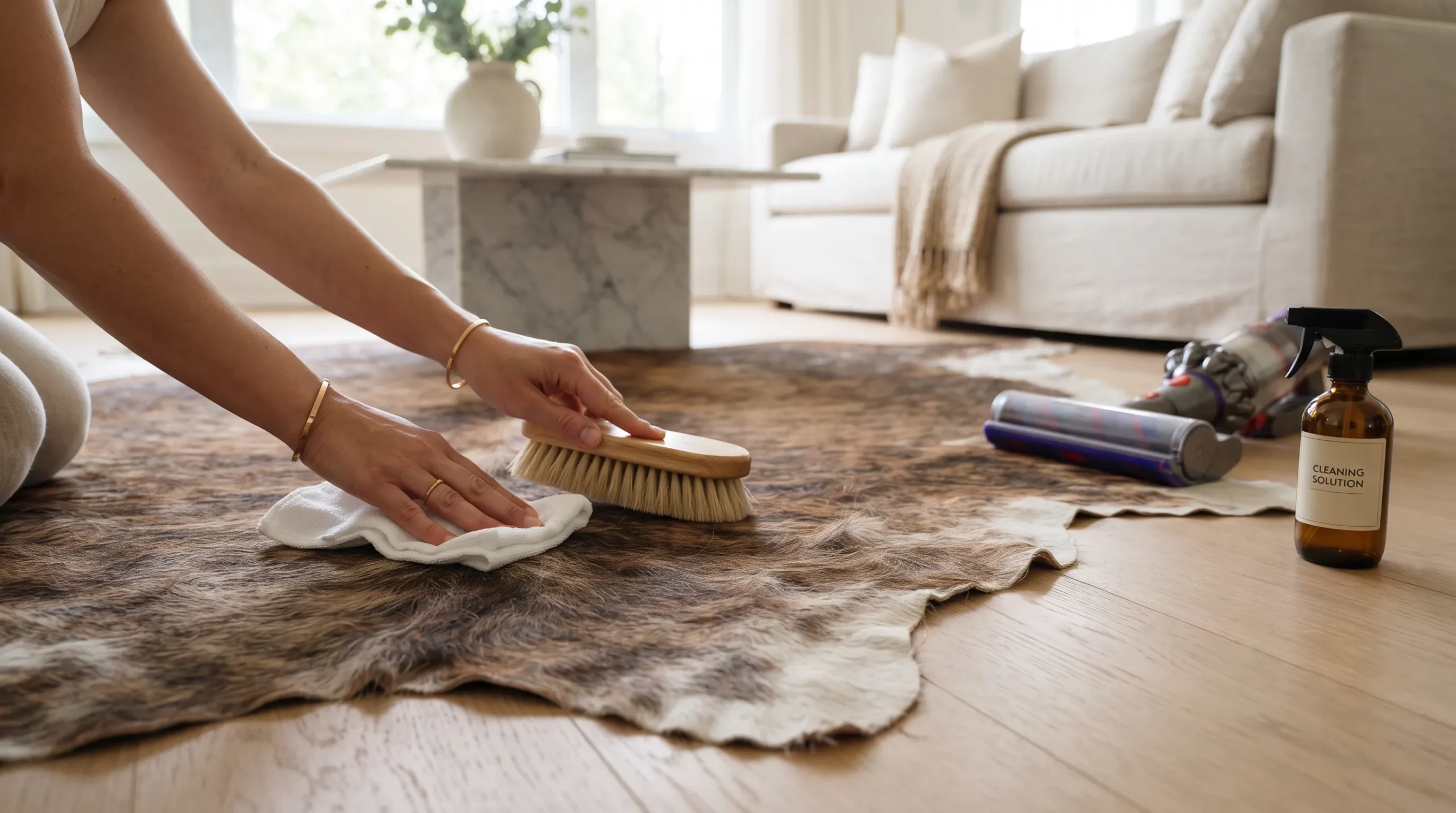
One of the strongest practical arguments for genuine cowhide is how little it asks of you in return for how long it lasts. A cowhide rug does not require professional cleaning on a schedule. It does not need specialist products. It does not demand the kind of cautious handling that makes some natural rugs feel more like objects to protect than pieces to live with.
What it does require is the right approach when maintenance is needed because the wrong technique on a genuine hide can cause real damage that the right technique would have prevented entirely.
This guide covers everything: daily care, spill response, stain removal, long-term maintenance, and the storage and flattening situations that come up less often but matter when they do.
Daily and Weekly Cowhide Rug Care
A cowhide rug is naturally durable and relatively low-maintenance, but consistent care helps preserve its appearance and extend its lifespan.
Shaking
The simplest and most effective regular maintenance for a cowhide rug is also the most overlooked. Take the rug outside every week or two, hold it at one end, and give it a firm shake. This dislodges dust, pet hair, and loose debris that has settled into the hair layer far more effectively than vacuuming does and without the risk of mechanical damage from a vacuum head.
For smaller hides, shaking is quick and easy. For larger hides, fold the rug in half along its length, carry it outside, then shake each half separately.
Brushing
A soft-bristled brush the kind used for suede or leather run through the hair in the direction of natural growth keeps the coat looking fresh between deeper cleanings. This is particularly useful in households with pets, where animal fur settles into the cowhide hair and resists shaking alone.
Brush in the direction the hair grows, not against it. Brushing against the grain can loosen hair from the hide over time.
Vacuuming
Vacuuming a cowhide rug requires more care than vacuuming a pile rug, but it is safe when done correctly.
Use the lowest suction setting available on your vacuum. Attach the upholstery brush the wide, soft-bristled attachment rather than the standard floor head. Run the vacuum in the direction of the hair growth only. Never vacuum against the grain, and never use a beater bar or rotating brush head directly on a cowhide. The mechanical action can pull hair from the hide and damage the surface of the leather.
A handheld vacuum on low suction works well for quick surface cleaning without the risk of dragging the rug or applying suction unevenly.
How to Handle Spills on a Cowhide Rug
Speed matters more than technique in the first moments after a spill on a cowhide rug.
Cleaning Liquid Spills
- Blot do not rub. Use a clean, dry white cloth or paper towels pressed firmly against the spill to absorb as much liquid as possible before it penetrates deeper into the hair layer.
- Work from the outside of the spill inward. Rubbing outward spreads the liquid across a larger area of the hide.
- Once the bulk of the liquid is absorbed, use a slightly damp cloth to gently wipe the affected area in the direction of the hair.
- Allow the area to air dry completely at room temperature. Do not use a hair dryer, heater, or direct sunlight to accelerate drying heat causes the hide to stiffen and can permanently alter its shape.
For water-based spills coffee, tea, juice, wine this process handles the majority of incidents without leaving a permanent mark, provided the response is fast.
Removing Solid Spills
Use a blunt-edged tool a spoon or the back of a butter knife to lift solid material off the surface of the hair before it presses deeper into the coat. Work gently and avoid dragging the debris across the hide. Once the solid material is removed, treat any remaining residue as a liquid spill.
How to Remove Common Stains
Different stains require slightly different cleaning methods. Using gentle cleaning techniques helps protect the hide while effectively removing marks.
Red Wine and Dark Liquids
Blot immediately as described above. For any remaining color after the area has dried, apply a small amount of mild leather cleaner to a clean white cloth never directly to the hide and work it gently into the stained area in circular motions. Wipe clean with a damp cloth, then allow to air dry.
Do not use household carpet stain removers on cowhide. Most contain chemicals enzymes, bleaching agents, alkaline compounds that damage the leather backing and can cause discoloration or hair loss.
Grease and Oil Stains
Sprinkle a small amount of cornstarch or baking soda over the affected area immediately after the spill. Allow it to sit for 15 to 20 minutes it will absorb the grease from the hair surface. Brush or shake the powder off gently, then assess. Repeat once more if necessary. For persistent grease stains, a very small amount of dish soap diluted heavily in water, applied with a cloth and blotted not rubbed can help lift remaining residue.
Mud and Dirt
Counter-intuitively, the right response to mud on a cowhide is to let it dry completely before attempting removal. Wet mud rubbed into the hair embeds deeper into the coat. Dried mud can be brushed or shaken off far more completely than wet mud can be wiped.
Once dry, brush the mud away with a soft-bristled brush moving in the direction of hair growth. Vacuum on low suction afterward to collect loose particles.
Pet Accidents
Blot urine immediately and thoroughly. Use a clean cloth to absorb as much liquid as possible, then wipe the area with a cloth dampened with a solution of equal parts cold water and white vinegar. The vinegar neutralizes the odor compounds in urine without damaging the hide. Allow to air dry completely.
For solid pet waste, remove it cleanly before it is pressed into the hair, then treat the area as above.
Avoid enzyme-based pet stain removers. While these work well on textile rugs and carpet, the enzymes can break down the protein structure of genuine leather, weakening the hide backing over time.
Cowhide Rug Care Do’s and Don’ts
| Do | Don’t |
| Shake regularly outdoors | Rub spills always blot |
| Vacuum on low suction with soft brush | Use rotating brush heads or beater bars |
| Brush in the direction of hair growth | Brush against the grain |
| Blot spills immediately | Use carpet stain removers |
| Use mild leather cleaner for stains | Use enzyme-based pet stain products |
| Air dry at room temperature | Use heat to dry (hair dryer, heater, sunlight) |
| Let mud dry before removing | Try to wipe wet mud off |
| Rotate the rug periodically | Leave the same area under heavy foot traffic indefinitely |
| Store rolled with hair facing inward | Store folded creasing damages the hide |
Protecting Your Cowhide Rug from Sunlight and Moisture
Environmental conditions have a significant impact on the longevity of natural cowhide. Protecting your rug from excessive sunlight and moisture helps preserve its color, texture, and flexibility.
Sunlight Exposure
Prolonged direct sunlight will fade the natural color of a cowhide rug over time particularly on dyed hides where the color is more susceptible to UV degradation. In rooms with significant south or west-facing sun exposure, position the rug away from the direct light zone, or use window treatments that filter UV during peak hours.
Natural undyed cowhides are more resistant to fading than dyed versions, but sustained direct sun will gradually lighten even natural markings over years of exposure.
Moisture and Humidity
Cowhide should not be saturated with water. Unlike textile rugs that can be wet-cleaned and dried, a cowhide that is soaked through will stiffen as it dries and may develop a misshapen, curled, or crinkled surface that is very difficult to reverse.
In humid environments coastal climates, basements, or rooms without adequate ventilation ensure the rug has airflow underneath it. Placing a rug pad beneath the hide elevates it slightly from the floor and allows air circulation, which reduces the risk of moisture accumulation on the underside.
If a cowhide rug gets significantly wet from flooding, a major leak, or an accident lay it flat in a well-ventilated space and allow it to dry naturally over 24 to 48 hours. Smooth it flat by hand while it is still slightly damp to prevent it from drying in a distorted shape.
How to Flatten Wrinkles and Curled Edges
New cowhide rugs sometimes arrive with creases or rolled edges from packaging and shipping. This is normal and almost always resolves on its own within a few days of being laid flat.
To accelerate flattening:
- Lay the rug hair-side down on a clean flat surface for 24 to 48 hours. The weight of the hide on its own backing encourages it to relax flat.
- Roll the affected area gently in the opposite direction of the crease for a few minutes, then lay flat again.
- In cases of persistent curling at the edges which can happen on hides that were stored rolled for extended periods place heavy, flat objects along the edges for a day or two. Books, cutting boards, or flat storage containers work well.
Never use steam directly on a cowhide rug to flatten it. Steam introduces significant moisture into the hide and can cause the same stiffening problems as water saturation.
Long-Term Cowhide Rug Maintenance
Regular preventive care helps your cowhide rug maintain its appearance and durability for years. A few simple habits can significantly extend its life.
Rotate the Rug Regularly
Rotate your cowhide rug 180 degrees every six to twelve months. This distributes foot traffic evenly across the hide rather than concentrating wear in the same area repeatedly. The paths where feet fall most often in front of sofas, at the foot of beds, at entry thresholds will show wear faster than the rest of the rug if it never moves.
Use a Rug Pad
Place a non-slip rug pad underneath your cowhide. This serves three purposes: it prevents the rug from shifting under foot traffic, it protects the leather backing from abrasion against hard floor surfaces, and it provides the slight elevation that allows airflow underneath the hide. Choose a thin, flat pad rather than a thick cushioned one cowhide does not need additional cushioning the way pile rugs do, and a thick pad can make the organic edges of the hide curl upward.
Professional Cleaning
For deep cleaning accumulated grime, severe staining, or hides that have not been cleaned in several years consult a professional leather and hide cleaner. This is not a routine requirement. Most well-maintained cowhide rugs will go years between professional cleanings. But when a hide needs more than surface care, professional treatment is worth the cost compared to the risk of DIY methods that damage the material.
How to Store a Cowhide Rug Properly
If you need to store your cowhide rug for an extended period, proper preparation is essential to prevent cracking, mildew and permanent creases
Before Storage
Vacuum and brush the rug thoroughly to remove dust and debris. Make sure the hide is completely dry before packing it away, as trapped moisture can lead to mold or unpleasant odors.
Best Storage Practices
- Roll the rug with the hair facing inward. This protects the hair surface from dust and compression damage during the storage period.
- Never fold a cowhide rug for storage. Folding creates permanent creases in the leather backing that are very difficult to remove.
- Store in a breathable covering a cotton sheet or breathable fabric bag rather than plastic. Plastic traps moisture and prevents the airflow the hide needs to stay in good condition.
- Store horizontally if possible, or standing upright on the rolled end. Leaning a rolled hide against a wall at an angle for extended periods can cause it to develop a curved shape that takes time to flatten out again.
Complete Cowhide Rug Cleaning Guide Additional cowhide rug care tips
How to Buy a Genuine Cowhide Rug
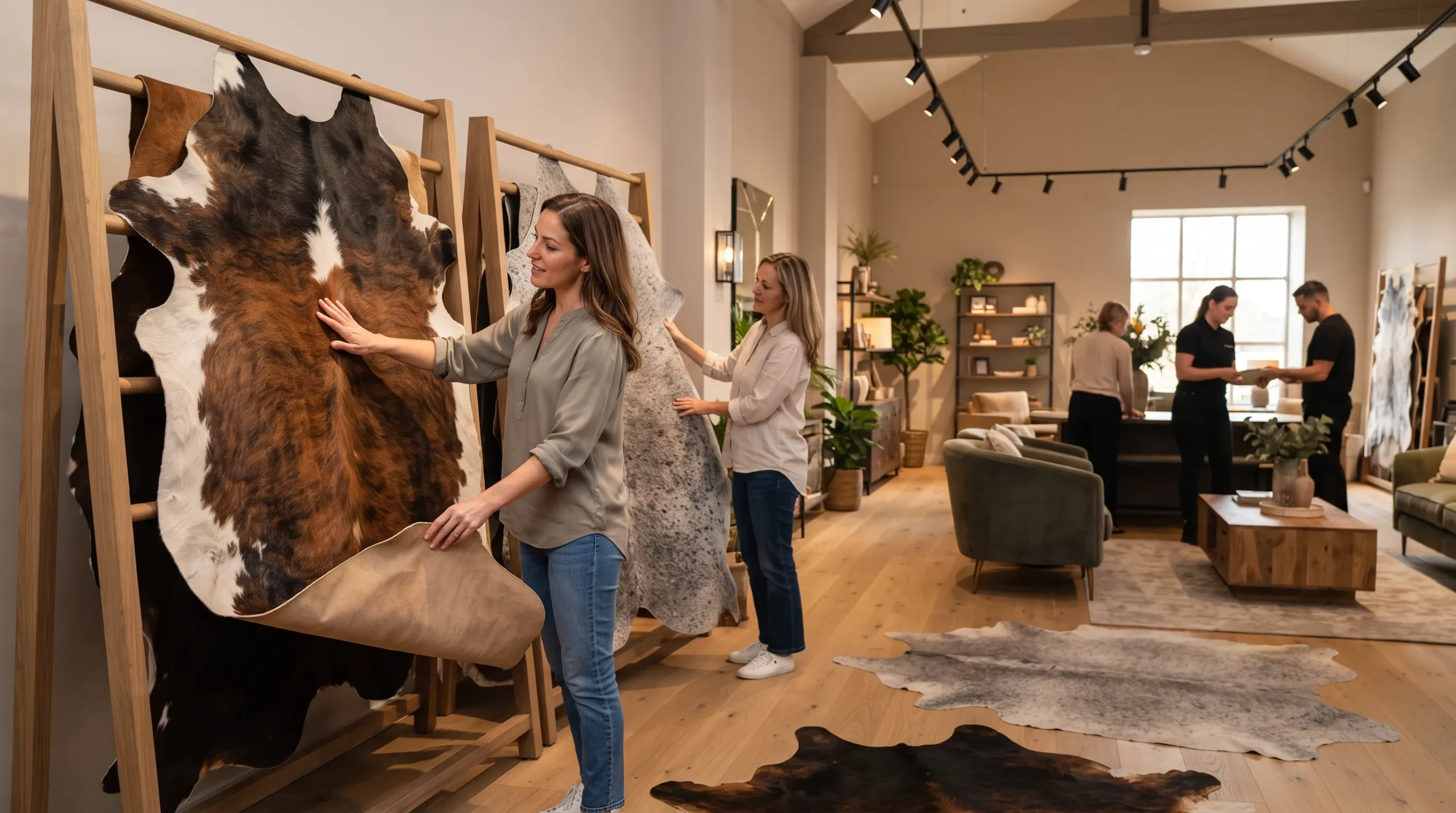
Knowing what you want in a cowhide rug and knowing how to evaluate what a seller is actually offering you are two different skills. Most buyers develop the first one quickly. The second one takes more deliberate attention and it is the one that determines whether the rug that arrives matches the rug you thought you were buying.
This section covers every factor worth evaluating before you place an order: material authenticity, quality indicators, seller practices, pricing expectations and the policies that protect you if something goes wrong.
1. Genuine vs. Faux Cowhide: Verify Before You Buy
The first and most important question is whether you are looking at a genuine cowhide rug or a synthetic imitation.
The cowhide market has a significant faux-product problem. Synthetic rugs printed with cow-pattern designs are sold under terms like “cowhide-style,” “cowhide-print,” and sometimes simply “cowhide rug” without clear disclosure. At a glance in a product photo, the difference can be subtle. In person, or with careful evaluation, it is not.
What genuine cowhide looks like:
- Each hide has a completely unique pattern no two product photos in a genuine seller’s catalog will show identical markings
- The shape follows the natural outline of a cow irregular, asymmetric, wider in the middle, tapering toward the legs and neck
- The hair has natural depth and variation some areas may be slightly denser or coarser than others
- The backing is leather firm, slightly textured, with a natural material smell when new
What synthetic cowhide looks like:
- Patterns repeat across multiple product listings the same spot distribution appearing on different “unique” pieces
- The shape is often more uniform and symmetrical than a natural hide
- The hair surface looks flat and consistent no natural variation in density or direction
- The backing is fabric or synthetic material
The simplest test: Look at multiple product photos from the same seller. If the patterns on their “cowhide rugs” repeat if you can find two listings with identical marking distributions you are looking at printed synthetic products, not genuine hides.
2. Hair Quality: What Good Looks and Feels Like
Hair quality is the most immediately visible indicator of a well-made cowhide rug, and one of the easiest to assess from good product photography.
Signs of good hair quality:
- Dense, even coverage across the full surface of the hide no thin patches where the hide is visible through sparse hair
- Consistent length across the hide typically 3 to 8 millimeters for finished cowhide rugs
- Natural sheen a well-finished hide catches light slightly, giving the hair a healthy, living quality
- Clean edges the hair transitions cleanly to the trimmed perimeter of the hide without fraying or pulling
Signs of poor hair quality:
- Visible bald patches or areas of significantly thinner coverage
- Dull, flat appearance with no natural sheen often a sign of over-processing or low-grade tanning
- Excessive shedding from day one some initial shedding is normal, but significant hair loss within the first week indicates poor anchoring during the finishing process
- Rough, coarse texture inconsistent with the rest of the hide suggests uneven processing
In product photography, good hair quality shows up as a surface with visible depth and slight variation in how light falls across it. Flat, uniformly lit surfaces with no texture differentiation are a warning sign either the photography is concealing the hide’s true condition, or the “hide” is synthetic.
3. Tanning Quality: The Foundation of Everything
Tanning is the process that transforms raw hide into a stable, usable material. It is invisible in the finished product but its quality determines almost everything about how the rug performs over time.
A well-tanned cowhide rug is soft and flexible. It lays flat without curling. It has no strong chemical or animal odor. It holds its shape under regular foot traffic and does not stiffen when exposed to minor moisture.
A poorly tanned hide does the opposite: it stiffens, curls at the edges, develops odor over time, and can begin to crack or deteriorate within a year or two of regular use.
You cannot assess tanning quality from a product photo. You assess it from seller transparency and buyer reviews.
What to look for:
- Sellers who describe their tanning process chrome-tanned, vegetable-tanned, or combination processes demonstrate product knowledge and sourcing transparency
- Customer reviews mentioning odor, stiffness, or curling after arrival are direct evidence of tanning quality issues
- A return window long enough to evaluate the hide in your home at least 14 days signals seller confidence in the tanning quality of their products
4. Shape Consistency and Edge Finishing
The shape of a genuine cowhide rug follows the natural outline of the animal. This is expected and desirable. What is not desirable is a hide with ragged, unfinished edges loose flaps of hide, fraying along the perimeter, or sections where the edge has not been trimmed clean.
Edge finishing is a craftsman skill. On a well-made hide, the perimeter is trimmed to follow the natural outline cleanly, with no sharp protrusions or uneven sections. The leather backing along the edge is smooth and consistent. The hair transitions to the trimmed edge without visible pulling or separation.
In product photography, look for close-up images that show edge detail. Sellers confident in their edge finishing will show it. Sellers using only distant overview shots of hides laid on floors may be concealing unfinished edges.
5. Color Quality on Dyed Hides
For natural cowhide rugs, color quality means the accuracy of the product photography does what you see in the listing reflect the actual tonal balance of the hide? This is entirely a photography and seller transparency issue.
For dyed cowhide rugs, color quality has an additional dimension: the consistency and depth of the dye application.
Signs of good dye quality:
- Natural markings remain visible through the dye the spot and patch patterns show through the color as tonal variation rather than being completely obscured
- The color is consistent across the full surface without patchy areas where the dye was applied unevenly
- The dye does not bleed significantly onto flooring or clothing on contact some minor initial transfer is normal, but heavy bleeding indicates poor fixation
Signs of poor dye quality:
- Flat, opaque color coverage with no visible natural pattern underneath
- Visible inconsistency in color depth across the hide
- No mention of dye type or process in the product description
6. Brazilian Cowhide vs. Other Origins
The term “Brazilian cowhide” appears frequently in the market and carries a quality connotation worth understanding.
Brazilian cattle particularly the Nelore breed are raised in conditions that produce hides with dense, lustrous hair and minimal scarring. The Brazilian leather processing industry has well-established standards for tanning and finishing, and Brazilian hides have a consistent reputation for quality in the international market.
However, “Brazilian cowhide” is also used as a marketing term by sellers who do not verify or cannot verify the actual origin of their hides. A rug labeled Brazilian is not automatically higher quality than one from another source and a high-quality hide from a skilled craftsman in Pakistan, properly processed and finished, will outperform a poorly processed Brazilian hide in every practical measure.
What matters more than the country of origin label is the verifiable quality of the specific hide: hair density, tanning quality, edge finishing, and the seller’s transparency about sourcing. Origin is a useful signal, not a guarantee.
7. Why Exact Hide Photography Matters
This is the single most important factor separating trustworthy cowhide sellers from unreliable ones and it is a practice that directly affects your purchase decision in ways nothing else does.
Most cowhide sellers use representative photography. They photograph one or two hides in each category tricolor, brindle, salt-and-pepper and use those images to represent the full range of hides they actually ship. The rug in your listing photo is a typical example of what you might receive. The rug in your package may look significantly different.
Sellers who photograph every individual hide before listing it operate on an entirely different standard. The hide in the product photo is the exact hide being sold. Its dimensions, its pattern distribution, its color balance all documented before the listing goes live. When you purchase it, that specific hide ships to you.
This practice matters because cowhide variation within a single category is significant. Two tricolor hides from the same batch can look entirely different one predominantly white with small dark patches, one balanced roughly evenly across all three tones. Buying the exact hide means no surprises. Buying from representative imagery means accepting meaningful uncertainty about what will actually arrive.
Ventinots photographs every individual hide before listing the rug in the listing is the rug in the package. This is the standard worth looking for from any cowhide seller, and it is one of the clearest indicators of a seller who takes product transparency seriously.
8. Shipping Considerations
Cowhide rugs are heavy, awkward to package, and require careful handling to arrive in good condition. Before purchasing, evaluate:
Shipping timeline: How long from order to delivery? A seller fulfilling from a domestic US warehouse Texas, for example can typically deliver within three to seven business days. Sellers shipping directly from overseas may quote two to four weeks.
Packaging quality: Good sellers roll hides rather than fold them for shipping folding creates permanent creases. Look for reviews mentioning packaging condition on arrival.
Insurance and tracking: Freight-level orders extra-large hides or multiple pieces should arrive with shipment tracking and basic insurance against loss or damage in transit. Verify this before ordering.
Free shipping: Many established cowhide sellers offer free shipping on standard-sized hides within the continental US. Factor shipping cost into price comparisons when it is not included.
9. Return Policies and What They Tell You
A return policy is not just a logistical convenience. It is a quality signal.
Sellers who offer 14 days or more from delivery, with straightforward return instructions and no excessive restocking fees, are confident enough in their product quality that they accept the financial risk of returns without penalizing the buyer for using the policy.
Sellers with no-return policies, very short windows, or heavy restocking fees are managing the financial risk of selling products that frequently disappoint customers. That is the only rational reason to structure a return policy that discourages its use.
What to look for:
- Minimum 14-day return window from delivery date
- Clear instructions for initiating a return
- No restocking fee, or a restocking fee explicitly disclosed upfront
- Clarity on who pays return shipping some sellers cover it, others require the buyer to arrange return freight
10. Pricing Expectations
Genuine cowhide rugs carry a higher price than synthetic alternatives because they are made from a real material by skilled craftsmen and exist in quantities limited by nature rather than production capacity.
Realistic price ranges for the US market:
| Size | Price Range (Genuine Cowhide) |
| Medium (roughly 4×4 ft, ~20 sq ft) | $140 – $160 |
| Large (roughly 5×5 ft, ~30 sq ft) | $160 – $180 |
| Extra-large (roughly 6×6 ft, ~40 sq ft) | $180 – $200 |
| Dyed hides | $250 – $300 |
| Patchwork (large format) | $150 – $400, depending on size |
Prices significantly below these ranges for products described as genuine cowhide warrant skepticism. The material and labor costs involved in producing a quality hide make deep discounting on genuine products unsustainable.
Prices significantly above these ranges are not automatically a quality indicator. A manufacturer-direct brand one that sources directly from craftsmen without passing through multiple wholesale tiers can offer genuine quality at the lower end of the genuine cowhide price range precisely because the retail margin is not inflated by intermediary markups.
11. Customer Reviews: What to Read and What to Ignore
Customer reviews on cowhide rugs are useful for assessing a handful of specific quality indicators and largely noise for everything else.
Reviews worth reading carefully:
- Comments about odor on arrival and whether it dissipated this speaks to tanning quality
- Mentions of curling edges or stiffness after a few weeks tanning quality again
- Comments about whether the received rug matched the product photos seller transparency
- Long-term reviews (six months to two years after purchase) about durability and maintenance
Reviews worth discounting:
- One-star reviews about shipping delays logistics vary and are not a product quality indicator
- Reviews complaining that the rug looked different from the photo when the seller uses representative imagery this is expected behavior from sellers who photograph representative hides, not a product defect
- Reviews about color appearing different on screen than in person monitor calibration varies
Common Cowhide Rug Buying Mistakes (And How to Avoid Every One)
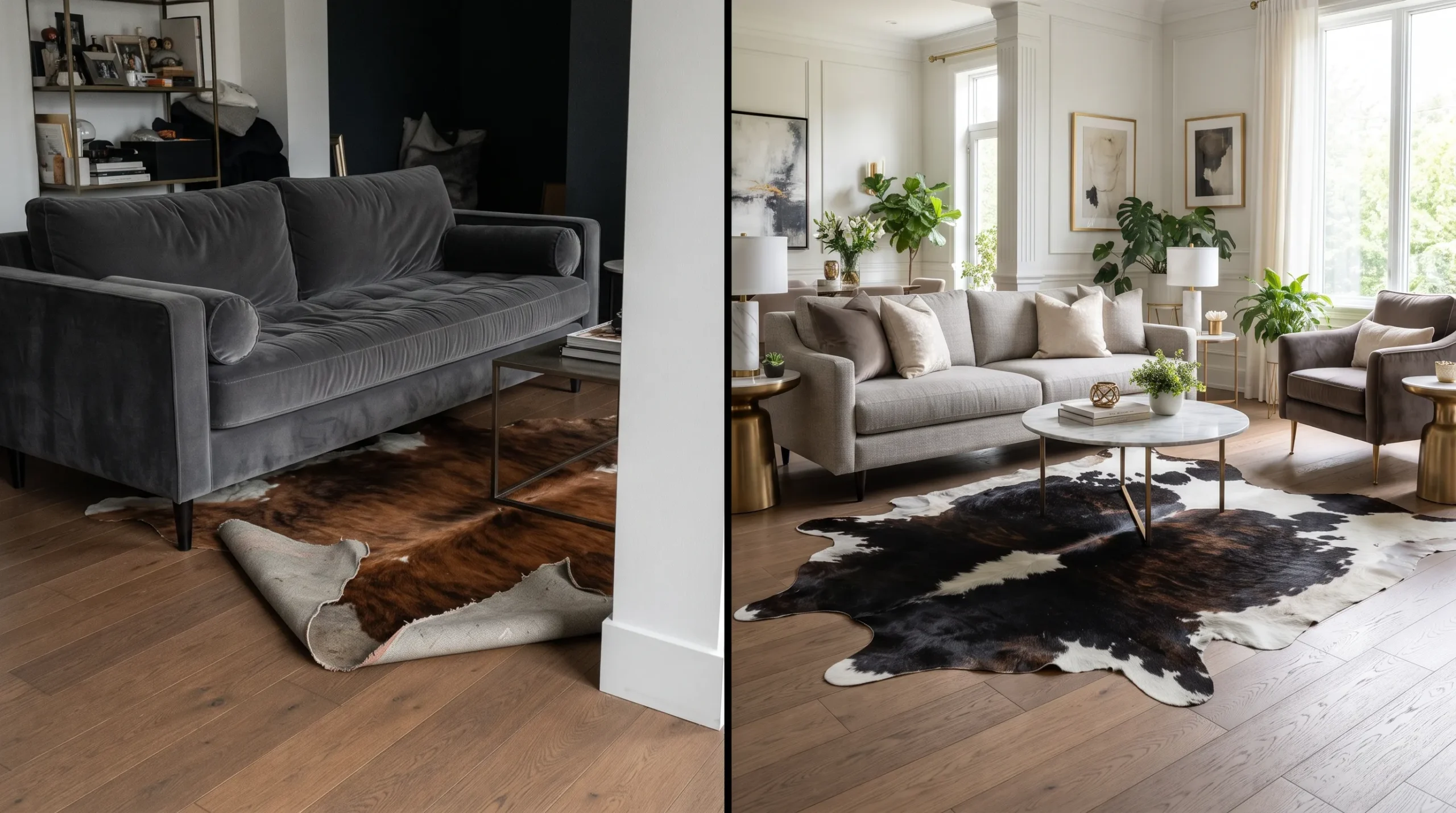
Most cowhide rug purchases that end in disappointment share a common thread: the buyer made a decision that felt reasonable at the time but was based on incomplete information. The rug arrived looking different from the photo. The size was wrong for the room. The material felt nothing like expected. The edges curled within weeks.
None of these outcomes are inevitable. They are predictable and preventable once you know what to watch for.
Here are the most common mistakes first-time and repeat buyers make, and exactly how to avoid each one.
Mistake 1: Buying a Synthetic Rug Thinking It Is Genuine Cowhide
This is the most costly mistake in the category not because synthetic rugs are worthless, but because buyers pay genuine cowhide prices for a product that will not last, does not have the same feel, and has none of the natural uniqueness that makes real cowhide worth owning.
Synthetic cowhide rugs are printed on fabric or polyester backing with cow-pattern designs. They look plausible in a product photo. In a room, the difference becomes obvious within minutes: the weight is wrong, the texture is flat, the pattern is identical to every other unit in the same batch.
How to Avoid This Mistake
Check whether the seller photographs each hide individually. If their tricolor listings all show the same spot distribution, or their brindle rugs look like the same hide photographed at different angles, you are looking at printed synthetic products. Genuine cowhide sellers cannot show you two identical hides because no two genuine hides exist. Individual photography is the clearest signal of authenticity available in an online purchasing context.
Mistake 2: Choosing the Wrong Size
Undersized rugs are the single most common source of decorator regret in the cowhide category. A beautiful hide that is four inches too small on each side looks like an afterthought rather than a design decision and no amount of repositioning fixes it.
This mistake happens for two reasons. First, buyers measure the footprint of the coffee table rather than the full seating arrangement, and choose a rug that fits only the table. Second, buyers size down to save money, which ultimately costs more because they either live with a rug that looks wrong or replace it.
How to Avoid This Mistake
Measure the full seating arrangement, not just the table. For living rooms, the rug should be large enough for the front two legs of every major seating piece to rest on it. For bedrooms, the hide should extend 18 to 24 inches on each side of the bed and at least 24 inches past the foot. For dining rooms, add 24 inches on every side of the table to account for chair movement. When in doubt between two sizes, choose the larger one.
Mistake 3: Ignoring the Room’s Existing Color Palette
A cowhide rug purchased because it looked good in someone else’s room on Instagram, in a magazine, in a friend’s living room does not automatically look good in yours. The materials, tones, and light conditions of the other room were doing work that your room may not replicate.
A bold tricolor that looked striking against white walls and light oak floors can feel heavy and visually busy in a room with warm walnut furniture and amber-toned walls. A salt-and-pepper hide that appeared elegantly minimal in a bright Scandinavian loft can disappear into the background in a room with low light and cool gray walls.
How to Avoid This Mistake
Start with your existing room, not with the rug you liked somewhere else. Identify the dominant tone warm or cool. Note the primary materials already in the room. Decide what role you want the rug to play anchor, accent, or statement piece. Then shop for a hide that serves those specific conditions rather than replicating someone else’s room.
Mistake 4: Not Checking Exact Product Photos
Buying a cowhide rug from representative photography is making a significant financial decision based on genuinely incomplete information. The phrase “color and pattern may vary” on a cowhide rug listing is not a minor disclaimer it is an acknowledgment that the product you receive may look substantially different from what you saw.
Pattern variation within a single cowhide category can be dramatic. Two tricolor hides described identically can look entirely different: one predominantly white with small scattered patches, one almost equally divided between black, brown, and white in large defined sections. From representative photography, you cannot tell which one you will receive.
How to Avoid This Mistake
Only purchase from sellers who photograph every individual hide before listing it. The hide in the product photo should be the exact hide being sold not a representative example of the category. Ask explicitly if you are unsure: “Is the rug shown in these photos the exact rug I will receive?” A confident seller will confirm it immediately. A hesitant or vague answer tells you everything you need to know.
Mistake 5: Skipping the Return Policy Check
Return policies feel like fine print until you need them. At that point, they become the most important words on the entire website.
Many buyers discover after purchase that the seller’s return window is five days from delivery, or that returns carry a 25 percent restocking fee, or that return shipping on a heavy cowhide hide is the buyer’s responsibility at full freight cost. Any of these conditions can make returning a disappointing rug financially equivalent to keeping it.
How to Avoid This Mistake
Read the return policy before adding anything to cart. Look for a minimum 14-day return window from delivery date, clear instructions for initiating a return, no punitive restocking fees, and clarity on who pays return shipping. A seller with a generous return policy is confident the product will arrive as represented. A seller with restrictive return conditions is managing predictable buyer disappointment.
Mistake 6: Buying Based on Price Alone
Cowhide rugs priced significantly below market rates for genuine products are almost never the bargain they appear to be. The material and labor costs involved in producing a quality hide proper tanning, skilled finishing, individual quality inspection have a floor below which genuine quality cannot be delivered sustainably.
A $79 “genuine cowhide rug” is either synthetic, poorly tanned, or both. It will curl, shed, stiffen, or degrade within months of regular use. The eventual cost of replacing it plus the inconvenience of the failed purchase exceeds what a correctly priced genuine hide would have cost at the outset.
How to Avoid This Mistake
Use realistic price benchmarks when evaluating options. Genuine M cowhide rugs in the US market typically start around $140. Large hides run $160 to $180. Extra-large pieces run $180 to $200, and premium dyed hides are priced higher, typically $250 to $300. Anything significantly below these ranges warrants careful scrutiny of the seller’s authenticity claims before purchasing.
Mistake 7: Misunderstanding Natural Variation
Some buyers purchase a genuine cowhide rug from a seller using individual hide photography and are still surprised when the product arrives looking slightly different from how it appeared on screen. This is not a product defect or a seller misrepresentation. It is the reality of purchasing a natural material viewed on a digital screen.
Monitor calibration, room lighting during photography, camera settings, and image compression all affect how a hide’s true color and marking intensity appear in a product photo versus in person. A brindle hide photographed in natural daylight against a light floor may appear slightly darker or lighter in your room depending on your light conditions.
How to Avoid This Mistake
Understand before purchasing that minor color and tone variation between a product photo and the received hide is inherent to buying natural materials online. This is different from pattern variation the spot distribution and marking layout of the exact hide you select should match accurately. The color temperature may shift slightly between the image and your room. Order from sellers who photograph in consistent, accurate lighting and who address this expectation clearly in their product descriptions.
Mistake 8: Neglecting Maintenance from Day One
A significant number of cowhide rugs that “wear out quickly” were not defective they were under-maintained. A hide that receives no shaking, no rotation, and no basic spill response will show wear and develop odor faster than the material warrants.
This mistake is particularly common with buyers who chose cowhide specifically because they heard it was low-maintenance. It is low-maintenance but low-maintenance does not mean no maintenance. The difference between a hide that lasts eight years and one that lasts twenty is almost entirely in the consistency of basic care.
How to Avoid This Mistake
Establish a simple routine from the day the rug arrives. Shake it outdoors every two weeks. Vacuum on low suction monthly in the direction of hair growth. Blot spills immediately rather than leaving them to set. Rotate the rug 180 degrees every six months to distribute wear evenly. These four habits take minimal time and extend the functional lifespan of a quality hide dramatically.
Mistake 9: Placing the Rug Without a Non-Slip Pad
A cowhide rug on a hard floor without a non-slip pad is a safety issue as much as a maintenance one. The leather backing on a genuine hide provides very little friction against polished hardwood, tile, or laminate the rug will slide underfoot, which is both dangerous and damaging to the backing over time.
Beyond safety, the friction of a hard floor against an unprotected leather backing causes abrasion that gradually degrades the hide from the underside. A rug pad prevents this while simultaneously allowing slight airflow beneath the hide that reduces moisture accumulation.
How to Avoid This Mistake
Purchase a thin, flat non-slip rug pad sized to your hide at the same time you purchase the rug. Avoid thick cushioned pads they raise the edges of an organic-shaped cowhide and create a trip hazard at the irregular perimeter. A flat, breathable pad designed specifically for hard floors is the right choice.
Mistake 10: Storing a Cowhide Rug Folded
This mistake typically occurs during a move, a renovation, or a seasonal switch the hide needs to be stored temporarily, and folding it seems like the obvious solution for a large, awkward piece.
Folding a genuine cowhide rug creates permanent creases in the leather backing along the fold lines. These creases are difficult to reverse and cause the rug to lay unevenly when laid flat again. In severe cases, the leather along a fold crease can crack over time, creating structural damage that is not repairable.
How to Avoid This Mistake
Always store a cowhide rug rolled never folded. Roll it with the hair facing inward to protect the surface, wrap in a breathable cotton sheet, and store horizontally or standing upright on the rolled end. If horizontal storage is not possible, ensure the rolled hide is supported along its full length rather than balanced at a single point.
Cowhide Rugs vs. Other Rugs: Which Is the Better Choice?
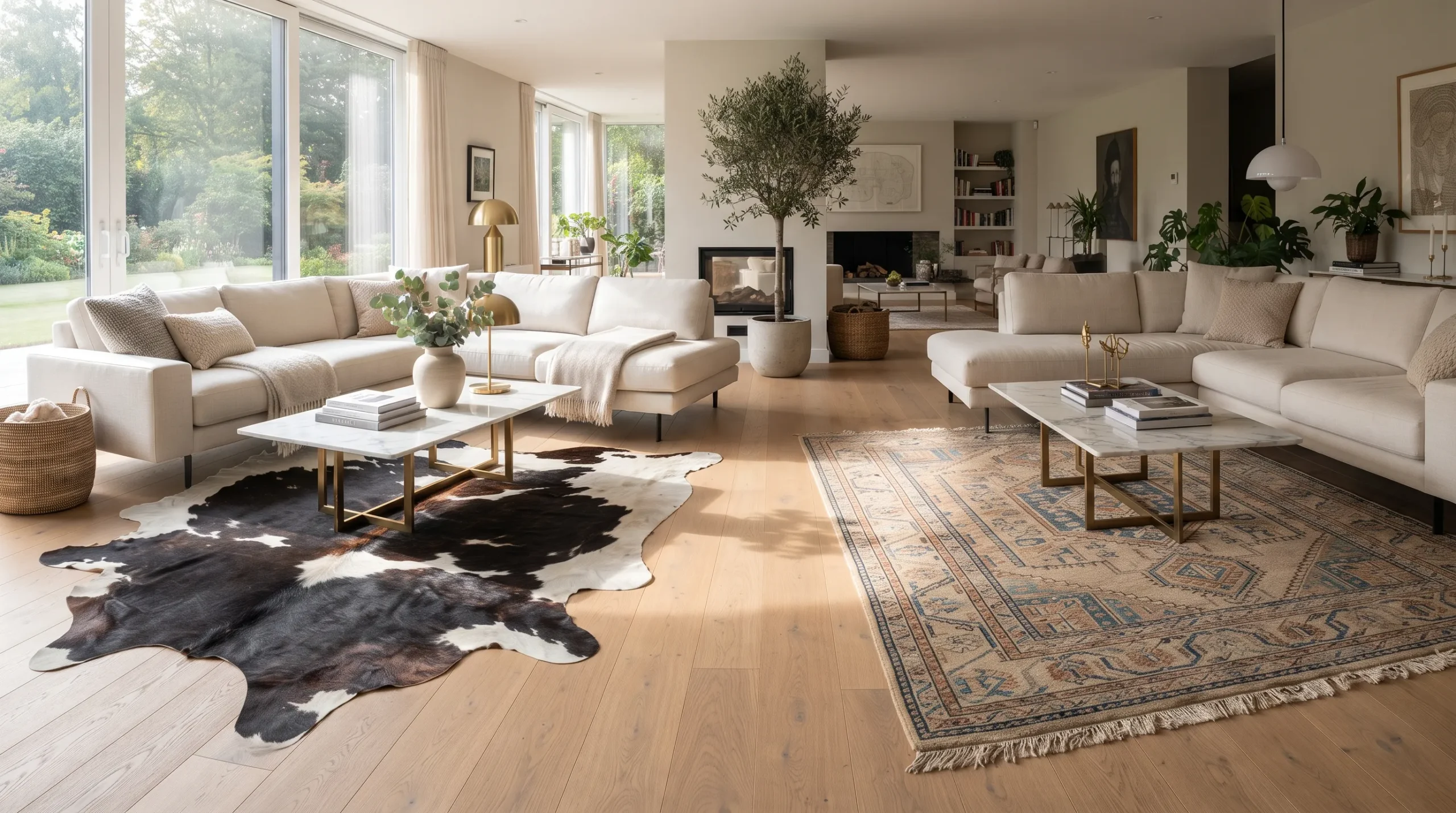
Choosing the right rug often comes down to comparing different materials. While genuine cowhide rugs are known for their durability and natural beauty, wool, synthetic and sheepskin rugs each have their own strengths. Understanding how they differ makes it easier to choose the best option for your home, lifestyle and budget.
The comparisons below highlight the key differences in durability, maintenance, comfort, appearance and long-term value.
Cowhide Rugs vs. Wool Rugs
Both cowhide and wool rugs are natural flooring options, but they offer very different benefits. Wool rugs are known for their soft, cushioned feel and traditional appeal, while genuine cowhide rugs stand out for their durability, easy maintenance and one-of-a-kind natural patterns. The comparison below highlights the key differences to help you decide which option best suits your home and lifestyle.
| Feature | Genuine Cowhide Rug | Wool Rug |
| Material | Natural hide with hair intact | Woven wool fibers |
| Typical lifespan | 10–20 years | 5–10 years (varies by quality) |
| Maintenance difficulty | Low shake, spot clean, vacuum on low | Medium regular vacuuming, professional cleaning recommended |
| Spill resistance | High liquids bead on hair surface | Low fibers absorb liquid quickly |
| Allergen resistance | High does not trap dust mites or pet dander | Low fibers trap allergens in deep pile |
| Shedding | Minimal on well-tanned hides | Common, especially in first year |
| Pattern uniqueness | Each hide completely unique | Machine-made patterns repeat |
| Softness underfoot | Dense, firm, warm | Soft and cushioned |
| Style versatility | Very high works across most design styles | High particularly suited to traditional and transitional interiors |
| Price range (medium) | $250–$400 | $200–$600 (wide quality range) |
| Best for | High-traffic areas, allergy-sensitive households, buyers valuing uniqueness | Soft underfoot comfort, traditional interiors, larger coverage needs |
Bottom line
Wool rugs offer more cushioning underfoot and are available in wider standard sizes. Cowhide rugs outlast most wool options in high-traffic placements, require less maintenance, and perform better in allergy-sensitive environments. For buyers who prioritize natural uniqueness and long-term durability over plush softness, cowhide is the stronger choice.
Cowhide Rugs vs. Synthetic Rugs
Genuine cowhide rugs and synthetic rugs may look similar at first glance, but they differ significantly in quality, durability, maintenance, and long-term value. Synthetic rugs are often chosen for their lower price and easy care, while genuine cowhide rugs offer natural beauty, exceptional longevity and a one-of-a-kind appearance that cannot be replicated. The comparison below highlights the key differences to help you make an informed buying decision.
| Feature | Genuine Cowhide Rug | Synthetic Rug |
| Material | Natural animal hide | Polyester, nylon, or acrylic |
| Typical lifespan | 10–20 years | 3–5 years |
| Pattern uniqueness | Every hide completely unique | Patterns repeat across units |
| Maintenance | Shake, spot clean, low-suction vacuum | Machine washable (most types) |
| Spill resistance | High | Varies some treated, many absorb quickly |
| Allergen resistance | High | Low fibers trap allergens and dust |
| Environmental impact | By-product, biodegradable | Petroleum-based, non-biodegradable |
| Off-gassing when new | None on quality hides | Common VOCs from synthetic materials |
| Price range (medium) | $250–$400 | $50–$200 |
| Best for | Long-term value, natural material, unique appearance | Tight budgets, machine-washable requirement, temporary use |
Bottom line
Synthetic rugs have a lower entry price and are often machine washable a genuine practical advantage for some households. Genuine cowhide rugs cost more upfront but last three to four times longer, do not off-gas chemicals, and deliver a material authenticity that synthetic products cannot replicate at any price point. Over a ten-year ownership period, genuine cowhide is almost always the more cost-effective choice.
Learn about indoor air quality and VOCs
Cowhide Rugs vs. Sheepskin Rugs
Both cowhide and sheepskin rugs are made from natural hides, but they are designed for different purposes. Sheepskin rugs are prized for their exceptionally soft, plush feel, while genuine cowhide rugs are valued for their durability, larger sizes, and distinctive natural patterns. Understanding the differences in comfort, maintenance, and everyday performance can help you choose the right rug for your space.
| Feature | Genuine Cowhide Rug | Sheepskin Rug |
| Material | Short-haired cow hide | Long-wooled sheep hide |
| Typical lifespan | 10–20 years | 5–10 years |
| Hair/wool length | Short 3 to 8mm | Long 50 to 100mm |
| Softness | Dense, firm, warm | Very soft and plush |
| Maintenance | Shake, spot clean, low vacuum | More delicate professional cleaning often needed |
| Spill resistance | High hair surface repels liquid | Low long wool absorbs liquid quickly |
| Allergen resistance | High | Medium longer fibers trap more than cowhide but less than synthetic |
| Pattern uniqueness | Every hide unique bold natural markings | Typically solid cream, white, or natural tones |
| Size availability | Medium to extra large single hides | Small to medium single pieces |
| Style versatility | Very high | High particularly Scandinavian, bedroom, nursery placements |
| Best for | High-traffic areas, bold natural pattern, long-term durability | Maximum softness, bedroom comfort, nurseries, accent placements |
Bottom Line
Sheepskin rugs offer the softest underfoot experience of any natural hide product ideal for bedrooms, nurseries, and beside-the-sofa accent placements where comfort is the primary goal. Cowhide rugs are more durable, easier to maintain, available in larger sizes, and carry bolder natural marking patterns. In high-traffic placements or rooms where a strong design statement is the goal, cowhide is the stronger performing option.
Where Should You Place a Cowhide Rug? Best Placement Ideas
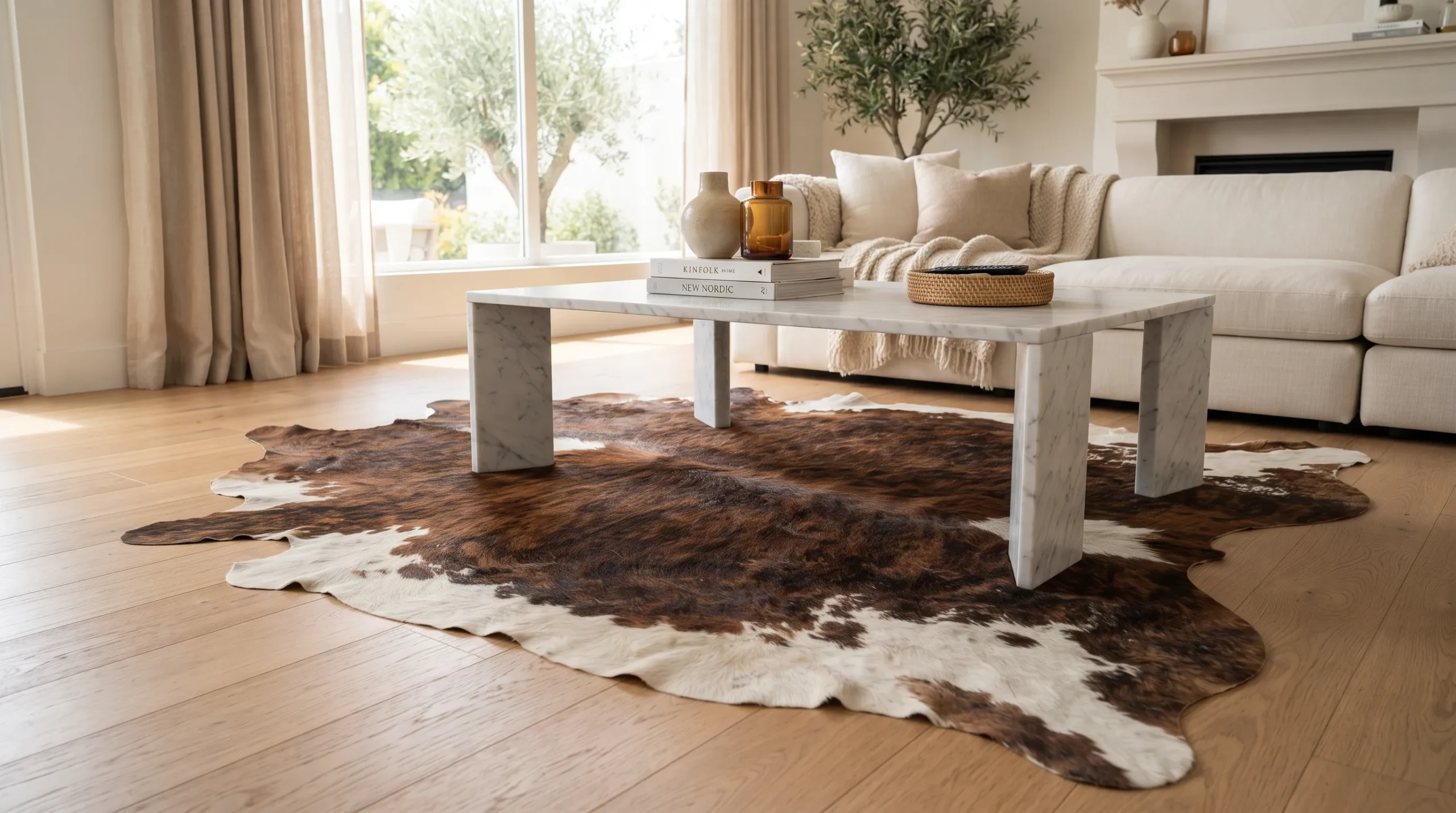
Cowhide rugs work in more placements than most buyers initially consider. The answer to where a cowhide rug should go is almost always: wherever you need natural warmth, texture, and durable floor coverage.
Here is a placement-by-placement breakdown of where genuine cowhide performs at its best.
Under a Coffee Table
The most common placement and one of the strongest. A large natural hide under a coffee table with the front legs of flanking sofas and chairs resting on the rug anchors the seating zone and gives the room a designed, intentional quality. Size matters more here than anywhere else: the rug needs to be large enough to accommodate the full furniture arrangement, not just the table footprint.
In the Bedroom
Position a hide under the bed two-thirds beneath the bed frame with 18 to 24 inches extending on each side and past the foot to create a warm landing zone that greets you every morning. A cowhide in this placement is also among the most practical bedroom choices for allergy-sensitive sleepers: no deep pile to trap dust mites, no fibers to accumulate allergens overnight.
In a Home Office
A medium hide under a desk and chair defines the work zone and signals that the space was designed with intention rather than assembled. The material durability handles chair wheel movement better than carpet does and does not develop the groove channels that pile rugs develop under repeated chair rolling. Use a chair mat over the cowhide if your chair wheels are particularly aggressive.
Layered Over Another Rug
Position a cowhide centered over a flat-weave jute, sisal, or low-pile wool base rug with 12 to 18 inches of base rug visible as a border on all sides. This creates visual depth and defines a zone more generously than either rug could alone. It also allows you to use a medium hide in a space that technically requires larger floor coverage the base rug provides the size, the cowhide provides the character.
Hung on a Wall
A genuine cowhide rug is not limited to the floor. A well-marked hide can also serve as a striking piece of wall décor, adding warmth, texture, and natural character to a room. Because every hide has a unique shape and pattern, it functions as a one-of-a-kind piece of natural artwork that often creates more visual impact than traditional framed art.
To hang a cowhide rug securely, use a wooden dowel inserted through fabric loops stitched along the top edge, or attach it with evenly spaced upholstery tacks that distribute the weight without damaging the hide. Proper support helps the rug hang flat while preserving its natural shape.
How to Hang a Cowhide Rug on the Wall
Best Places to Hang a Cowhide Rug
- Above a sofa: Creates a bold focal point in the living room while adding natural texture to the seating area.
- Behind a bed: Works as a unique alternative to a traditional headboard and adds warmth to the bedroom.
- On a stairwell wall: Fills tall, narrow spaces that are often difficult to decorate with conventional artwork.
- On a dining room accent wall: Adds visual interest and complements wood, leather and natural materials commonly found in dining spaces.
In a Dining Room
Position a large hide or rectangular patchwork rug under the dining table with at least 24 inches extending beyond the table on every side enough that dining chairs remain on the rug when pulled out for seating. Cowhide handles the food spill and foot traffic of a dining room better than most textile alternatives and adds natural warmth to a space that often has no soft furnishings at all.
In an Entryway
A small to medium cowhide in an entryway creates an immediate first impression while handling foot traffic and surface moisture better than any textile entry mat. Position it centered in the entry with equal space visible on both sides. The natural shape of the hide wider in the middle, tapering at the ends fills an entry floor more dynamically than a rectangular mat does.
Real Cowhide Home Styling Ideas
Are Cowhide Rugs Good for Pets? (Dogs, Cats & More)
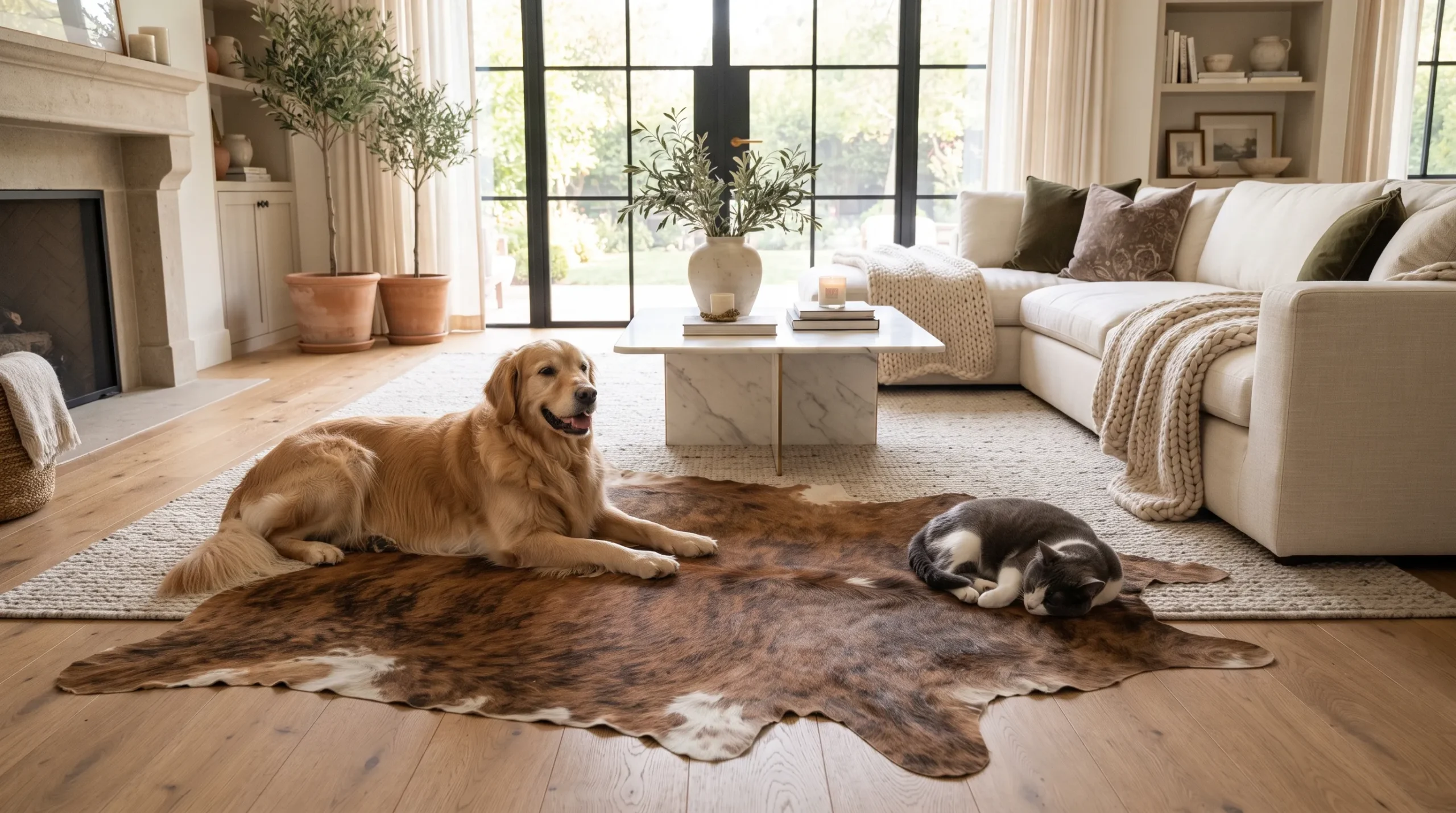
If you share your home with pets, it’s natural to wonder whether a genuine cowhide rug is a practical choice. The good news is that cowhide rugs generally perform very well in pet-friendly homes thanks to their durability, easy maintenance, and natural resistance to trapping pet hair. However, the right choice ultimately depends on your pet’s habits and behavior as much as the rug itself.
Cowhide Rugs and Dogs
For most dog owners, a genuine cowhide rug is one of the most practical natural flooring options available. Here’s why.
Pet Hair
Pet hair sits on the surface of a cowhide rug rather than embedding in deep pile fibers. Regular shaking or a soft brush passes through quickly. The cleanup effort is significantly lower than with a wool or shag rug where dog hair works its way into the pile and resists removal.
Liquid Accidents
Cowhide’s natural surface resistance means urine does not immediately saturate the hide the way it soaks into carpet or textile rugs. A prompt blot and a white vinegar and water wipe-down handles most incidents without leaving permanent damage or odor provided the response is fast.
Muddy paws
Dried mud brushes off a cowhide surface far more completely than it cleans from a woven pile rug. Allow the mud to dry fully before attempting removal wet mud pushed into the hair embeds deeper. Once dry, a soft brush in the direction of the hair growth and a low-suction vacuum removes most of it cleanly.
Dogs That Dig or Scratch
This is the meaningful risk. Some dogs particularly anxious dogs or working breeds with strong digging instincts will scratch at floor surfaces repeatedly. Concentrated scratching on one area of a cowhide rug will eventually pull hair from the hide. If your dog is a habitual floor scratcher, the placement of the rug matters: a cowhide in a low-traffic room where the dog spends little unsupervised time is a lower risk than one in the primary living area.
Cowhide Rugs and Cats
Cats are less predictable in their interaction with cowhide than dogs are.
Some cats are strongly attracted to the natural animal scent of a genuine hide particularly new hides that retain more of their natural leather character. This attraction can manifest as marking behavior or persistent interest that introduces hygiene issues. Other cats ignore the rug entirely after the first investigation.
There is no reliable way to predict which response your cat will have before the rug arrives. If you have a cat that has previously shown marking behavior on new items, placing a cowhide rug in the household involves some risk.
Cat scratching on a cowhide is less of a concern than it initially sounds. Casual scratching the kind cats do on furniture edges and carpet corners does not damage a cowhide surface significantly. It is concentrated, repeated scratching in the same spot over weeks that eventually thins the hair in that area.
Practical Tips for Pet Owners
Use a rug pad: A non-slip pad under the cowhide prevents the rug from sliding when pets run across it or launch off it. This protects both the rug and the pet from the instability of a sliding surface.
Act on accidents immediately: The single most important maintenance behavior in a pet household is speed of response to liquid accidents. The difference between a blotted, cleaned spill and a set stain is almost entirely how quickly the response happens. Keep a clean cloth accessible in any room where the rug is placed.
Choose placement thoughtfully: A cowhide rug in a room where pets spend most of their time unsupervised faces more risk than one in a room with regular human presence. Consider the specific habits of your animals when deciding where to place a hide.
Avoid enzyme-based cleaners: As noted in the maintenance section, enzyme cleaners that work well on textile rugs and carpet can break down the protein structure of genuine leather over time. Use a white vinegar and water solution for odor neutralization and a mild leather cleaner for staining nothing stronger.
Are Cowhide Rugs Ethical? What You Need to Know
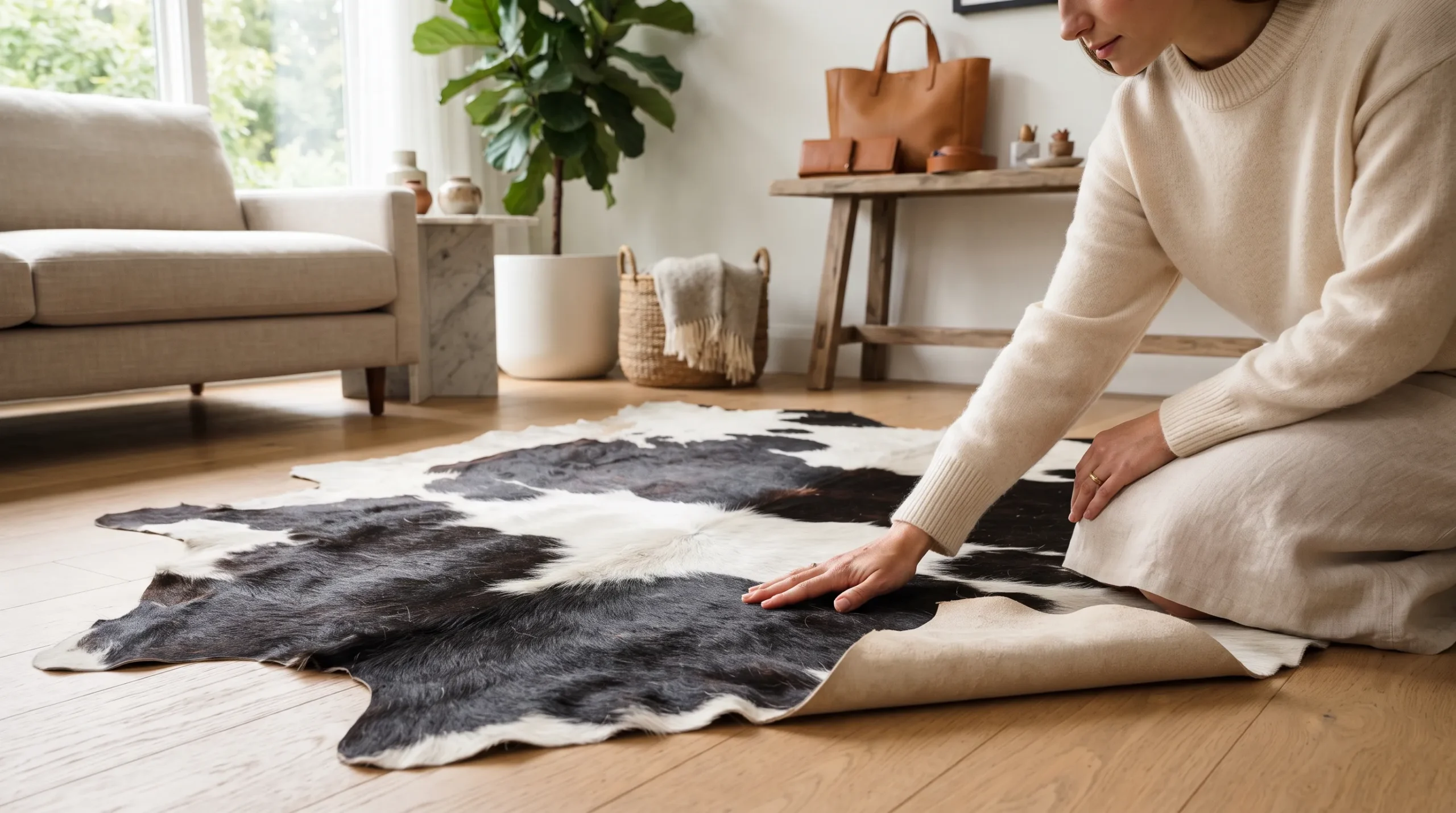
It is a fair question and it deserves a more complete answer than most cowhide sellers provide.
Are Cowhide Rugs Ethical?
The short answer is this: genuine cowhide rugs are a by-product of the beef industry. The hides used to make them come from cattle already processed for meat. They would otherwise be discarded as waste material during that process. Using them as rugs reduces waste from an existing industry rather than creating demand for additional animal use.
That distinction matters when evaluating the ethics of the purchase.
The By-Product Argument
Cowhide rugs are not driving a separate industry of cattle raised specifically for their skin. The animals from which these hides come were raised for beef a global industry that operates entirely independently of the cowhide rug market. The hide is what remains after meat processing. Without the leather and hide industries that utilize these by-products, that material goes to landfill.
Choosing a genuine cowhide rug does not increase the demand for cattle production. It reduces the waste generated by production that is already happening.
This is a meaningfully different ethical position than purchasing products made from animals raised primarily for non-food purposes.
Genuine Cowhide vs. Synthetic: The Environmental Comparison
Many buyers assume that choosing a synthetic alternative to genuine cowhide is the more environmentally responsible decision. The full picture is more complicated.
Synthetic cowhide rugs are produced from petroleum-based materials polyester, acrylic, nylon that require significant energy to manufacture, do not biodegrade at end of life, and contribute to microplastic pollution as they shed fibers during use and washing. A synthetic rug that lasts three to five years before requiring replacement generates ongoing material waste across its shortened lifecycle.
A genuine cowhide rug produced as a by-product of existing beef processing, lasting 10 to 20 years with basic maintenance, and biodegrading naturally at end of life presents a different environmental profile than its synthetic alternative not a perfect one, but a more durable and ultimately less wasteful one across the full ownership period.
Neither option is without environmental cost. But the assumption that synthetic equals ethical and natural equals harmful does not survive careful examination in this category.
Sourcing Transparency Matters
The ethical quality of a cowhide rug purchase is also affected by how transparently the seller discloses their sourcing. A brand that is open about where hides come from, how craftsmen are compensated, and what quality and inspection standards apply throughout production gives buyers the information they need to make an informed decision.
Ventinots is straightforward about this: hides are sourced in partnership with craftsmen in Pakistan a region with a generational tradition of leather and hide craft and fulfilled from their Texas warehouse. The craftsmen they work with are skilled artisans for whom cowhide work is a primary livelihood, not an outsourced secondary operation.
Transparency about sourcing does not make every ethical question disappear. But it does allow buyers to evaluate what they are purchasing with accurate information rather than marketing language.
Learn more about responsible leather manufacturing practices Learn about sustainable materials management
Why Choose Ventinots for Your Cowhide Rug
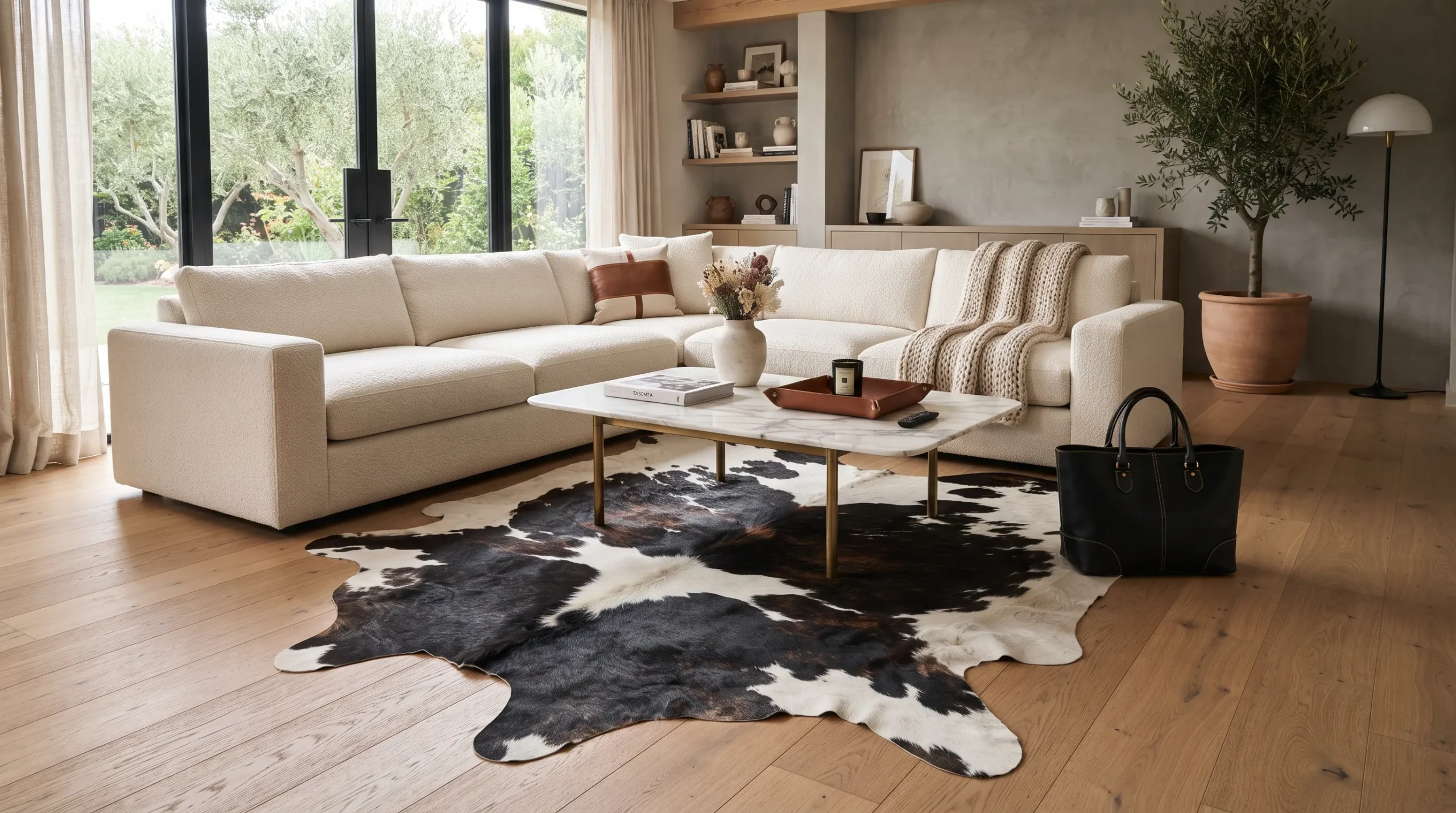
Throughout this guide, we have covered what makes a cowhide rug genuinely good: quality tanning, honest photography, skilled finishing, transparent sourcing, and a seller who stands behind what they ship. Ventinots was built around every one of those standards not as marketing language, but as the operational commitments that determine how the business actually runs day to day.
This section explains specifically what Ventinots does differently, and why those differences matter when you are spending meaningful money on a piece that is meant to last years.
Individual Hide Photography Every Single Piece
Most cowhide sellers photograph one or two representative hides per category and use those images across their full inventory. You select what you see in the listing. What arrives may look substantially different different pattern distribution, different color balance, different proportions.
Ventinots photographs every individual hide before it is listed. The rug in the product photo is not a similar piece or a representative example. It is the exact rug being sold with its own dimensions, its own marking distribution, its own color balance documented before the listing goes live.
When you purchase a specific hide from Ventinots, that hide ships to you. Not a comparable one. Not a similar piece from the same batch. The one you chose.
This practice eliminates the most common source of disappointment in the cowhide category: the gap between what you selected and what arrives. It also means every listing on the Ventinots site represents a genuinely unique piece because every genuine hide is unique, and their photography reflects that reality rather than concealing it.
Manufacturer-Direct Sourcing
Ventinots is not a retailer purchasing finished inventory from distributors. It is a manufacturer-direct brand which means it sources premium hides, works directly with skilled craftsmen, and controls the production process from raw material to finished product.
This matters for two reasons.
First, quality oversight. When a brand works manufacturer-direct, it can specify finishing standards and have them applied consistently edge trimming, hair treatment, backing preparation rather than accepting whatever a wholesale supplier delivers. Ventinots’ craftsmen are people who work with cowhide as a primary skill, not a secondary process. The tanning, trimming, patchwork stitching, and finishing at every stage are handled by artisans who have executed those specific tasks hundreds of times.
Second, pricing. A manufacturer-direct brand removes the wholesale and distribution markups that inflate the retail price of most cowhide products without adding anything to the quality of the hide itself. Ventinots can offer genuine craftsmanship at a price point that does not require a luxury retail margin to be sustainable because the margin is not being split across three or four intermediaries before the product reaches the customer.
Skilled Craftsmanship from Pakistan
Ventinots’ products are made by craftsmen in Pakistan a region with a long, well-established tradition of working with leather and hide. The craftsmen they partner with come from communities where this knowledge passes directly between generations. It is not classroom-taught. It is practiced daily over the course of careers, which means the failure points a poorly finished edge that separates within months, a patchwork seam that comes apart under foot traffic are known and avoided because they have been encountered and learned from.
This is stated openly because Ventinots believes the craftsmanship is worth crediting and the sourcing is worth being transparent about. The products are made in Pakistan. They are fulfilled from Texas. Both parts of that matter, and neither is something the brand has any interest in obscuring.
Fulfilled from Texas Fast, Domestic Shipping
Every Ventinots order ships from its warehouse in Richmond, Texas. This means domestic US shipping timelines not the two-to-four-week international transit that overseas-fulfilled orders involve. It also means the order is subject to US shipping standards, carrier accountability, and the straightforward tracking and insurance that domestic fulfillment provides.
For buyers who need a rug for a specific project, a renovation deadline, a gifting occasion, a room that has been waiting on a single piece the difference between domestic and international fulfillment is not minor. Fast, trackable domestic shipping from a US warehouse is one of the clearest operational advantages Ventinots has over competitors fulfilling directly from overseas.
Multiple Quality Inspections Before Dispatch
Each hide that arrives at Ventinots’ Texas warehouse has already been inspected at the source in Pakistan. It is inspected again before photography at which point any hide that does not meet quality standards is set aside rather than listed. It is inspected again before dispatch.
Multiple inspection points at different stages of the process mean that what ships to you has been reviewed by multiple sets of hands with different vantage points. The source inspection catches material and tanning issues. The pre-photography inspection catches finishing and appearance issues. The pre-dispatch inspection catches anything that may have changed during warehousing.
This layered review process is how Ventinots ensures that individual photography is meaningful the hide photographed is the hide that ships, and it is in the condition shown.
14-Day Return Policy
Ventinots offers a 14-day return policy from delivery. In the context of this guide’s earlier discussion of what return policies signal about seller confidence, that is worth noting plainly: a seller offering 14 days from delivery on individual hides that vary in weight, size, and appearance is accepting real financial risk on the assumption that their products will arrive as represented.
That assumption is only sustainable if the products consistently do arrive as represented. The 14-day window is not a generous marketing gesture it is the operational expression of confidence in what they ship.
Direct, Accessible Customer Support
Ventinots’ contact information phone number, email, and WhatsApp is publicly listed on the website. Their office is in Austin, Texas.
This sounds straightforward because it should be. In practice, many online retailers in the home décor space route customer service through ticket queues, chatbot interfaces, and offshore support teams with limited authority to resolve order issues. Ventinots’ model is direct contact with a team that can answer questions before purchase and address issues after it without the intermediary layers that slow resolution and frustrate customers.
If something is wrong with your order, you can reach the people responsible for fixing it. That is a meaningful operational commitment, not a feature.
What Ventinots Offers
For buyers evaluating Ventinots against other options in the cowhide market, the relevant comparison points are:
- Every hide individually photographed the listing shows the exact piece
- Manufacturer-direct sourcing with direct craftsman relationships in Pakistan
- Multiple quality inspections before photography and before dispatch
- Domestic US fulfillment from Richmond, Texas
- 14-day return policy from delivery
- Direct customer support by phone, email, and WhatsApp
- A full product range spanning natural cowhide rugs, dyed hides, patchwork formats, leather bags, belts, wallets, pillow covers and accessories
The cowhide market has a specific trust problem most sellers use representative photography and provide limited transparency about sourcing. Ventinots’ approach addresses both of those issues directly, which is why buyers who care about knowing exactly what they are purchasing keep coming back.
Browse the full cowhide rug collection at Ventinots to see the current available hides. Every listing shows the exact piece. Every piece is unique. Take your time that is exactly what the individual photography is for.
Frequently Asked Questions
-
What is a genuine cowhide rug?
A genuine cowhide rug is the processed and finished hide of a cow, with the natural hair intact, used as a floor covering or decorative piece. Each hide retains its original shape, markings, and hair pattern making every genuine cowhide rug completely unique. Unlike synthetic alternatives, no two genuine hides are identical.
-
How can I tell if a cowhide rug is real or fake?
Check three things. First, look at the shape genuine hides follow the natural outline of a cow, which is asymmetric and irregular. Second, check the pattern genuine hides in the same category will all look different. If a seller’s tricolor listings show identical spot distributions, they are selling printed synthetics. Third, check the backing genuine cowhide has a leather backing with natural texture. Synthetic rugs have fabric or foam backings.
-
Are all genuine cowhide rugs unique?
Yes. Every genuine cowhide rug carries the exact markings of one individual animal. The spot distribution on a tricolor hide, the striping on a brindle, the density and balance of a salt-and-pepper none of these can be replicated because they are determined by nature, not manufacturing. No factory run produces two identical genuine hides.
-
Where do cowhide rugs come from?
Genuine cowhide rugs are a by-product of the beef industry. The hides are sourced after cattle have been processed for meat, then sent to tanneries where they are cleaned, stabilized, and finished. Ventinots works with craftsmen in Pakistan a region with a long tradition of hide and leather craft and fulfills all orders from its Texas warehouse.
-
What does “manufacturer-direct” mean for cowhide rugs?
A manufacturer-direct brand sources and produces its own products rather than purchasing finished inventory from distributors or wholesale suppliers. This means tighter quality control at every stage hide selection, tanning oversight, finishing standards and a more direct line between the craftsmen who make the product and the customers who receive it. It also typically means better pricing because wholesale and distribution markups are removed from the equation.
-
Are cowhide rugs ethical?
Genuine cowhide rugs are by-products of the beef industry the hides come from cattle already processed for meat, which means the rugs are not driving additional animal use. Using the hide rather than discarding it reduces waste from an existing industry. For buyers concerned about animal welfare, this by-product distinction is meaningful. Synthetic alternatives, by contrast, are made from petroleum-based materials with their own environmental costs.
-
Is buying a cowhide rug bad for the environment?
The environmental calculus is more nuanced than it first appears. Genuine cowhide rugs repurpose a by-product that would otherwise be discarded, last 10 to 20 years with proper care, and biodegrade at end of life. Synthetic rugs are made from petrochemicals, have shorter lifespans, and do not biodegrade. Neither option is environmentally neutral, but genuine cowhide’s longevity and by-product status compare favorably to synthetic alternatives over a full product lifecycle.
-
Are cowhide rugs cruelty-free?
Cowhide rugs are not produced from animals raised specifically for their hides the hides are sourced as by-products of existing beef production. Whether this meets a personal definition of cruelty-free depends on an individual’s broader view of animal agriculture. For buyers who consume beef or leather goods, a cowhide rug is consistent with those existing choices.
-
Do cowhide rugs smell?
A properly tanned and finished genuine cowhide rug has no unpleasant odor. Some hides arrive with a faint natural leather smell that dissipates within a few days of being laid flat in a ventilated room. A strong chemical smell or persistent animal odor after the first week is a sign of poor processing not an inherent characteristic of genuine cowhide.
-
Do cowhide rugs shed?
Minimal shedding during the first few days after unboxing is normal as the hide settles into its environment. Beyond that initial period, a well-tanned genuine cowhide rug sheds very little significantly less than wool, shag, or long-pile synthetic rugs. Excessive ongoing shedding is a quality issue indicating inadequate tanning or poor hair anchoring during finishing.
-
Are cowhide rugs soft?
Yes. A well-finished genuine cowhide rug has a soft, dense hair surface that is comfortable underfoot. The hair is typically 3 to 8 millimeters in length shorter and denser than shag or wool pile, but with a natural warmth and texture that most people find genuinely pleasant to walk on barefoot.
-
Are cowhide rugs slippery?
The hair surface of a cowhide rug can be slippery on smooth hard floors particularly hardwood, tile, or polished concrete. Placing a non-slip rug pad underneath the hide solves this completely. A flat, thin rug pad designed for hard floors is the right choice it prevents movement without raising the edges of the hide or creating a trip hazard.
-
How long do cowhide rugs last?
A genuine cowhide rug properly cared for typically lasts 10 to 20 years. The longevity depends on three factors: the quality of the tanning, the level of foot traffic in the placement area, and how consistently basic maintenance is applied. Hides placed in moderate-traffic areas living rooms, bedrooms with regular shaking and occasional vacuuming routinely last 15 years or more.
-
Are cowhide rugs durable enough for high-traffic areas?
Yes. Genuine cowhide handles high-traffic placement entryways, living rooms under coffee tables, dining rooms better than most textile alternatives at comparable price points. The material does not thin, compress, or develop worn channels the way woven pile rugs do under repeated foot traffic.
-
Do cowhide rugs wear out?
Over many years of heavy use, the hair on a cowhide rug can become slightly thinner in the highest-traffic zones. This is a very slow process typically visible only after a decade or more of consistent use. Rotating the rug 180 degrees every six to twelve months distributes the wear evenly and significantly extends the period before any thinning becomes noticeable.
-
Can cowhide rugs be repaired?
Minor edge damage small tears or sections where the hide has dried and cracked along the perimeter can be addressed by a professional leather repair specialist. Hair loss in small areas is more difficult to repair invisibly. The best approach is prevention: proper maintenance, a rug pad to protect the backing, and rotation to distribute wear.
-
Can you vacuum a cowhide rug?
Yes, with the right technique. Use the lowest suction setting on your vacuum and a soft upholstery brush attachment. Always vacuum in the direction of the hair growth never against it. Never use a rotating brush head or beater bar directly on a cowhide rug. For most households, regular shaking outdoors is more effective than vacuuming and carries no risk of mechanical damage.
-
Can cowhide rugs get wet?
Minor moisture a wiped spill, a damp cloth used for cleaning is fine and part of normal maintenance. Saturation is the problem. A cowhide rug soaked through will stiffen as it dries and may develop a distorted or crinkled shape that is difficult to reverse. If a hide does get significantly wet, lay it flat in a well-ventilated space and allow it to air dry naturally without applying heat.
-
Can you wash a cowhide rug in a washing machine?
No. Machine washing a genuine cowhide rug will damage it irreparably the agitation, saturation, and heat of a wash cycle will cause the leather backing to stiffen, shrink, and potentially crack, while the hair surface loses its natural condition. Cowhide rugs are not machine washable under any circumstances.
-
How do you remove stains from a cowhide rug?
For liquid stains, blot immediately with a clean dry cloth never rub. Work from the outside of the spill inward. For stubborn stains after the area has dried, use a small amount of mild leather cleaner on a cloth and work gently in circular motions, then wipe clean and air dry. Avoid carpet stain removers, bleach, enzyme-based products, and any cleaner not specifically formulated for leather or hide.
-
How do you get pet urine out of a cowhide rug?
Blot immediately and thoroughly with a clean dry cloth. Then wipe the area with a cloth dampened with equal parts cold water and white vinegar the vinegar neutralizes urine odor compounds without damaging the hide. Allow to air dry completely. Avoid enzyme-based pet stain removers, which can break down the protein structure of genuine leather over time.
-
How do you get wrinkles out of a cowhide rug?
Most new cowhide rugs arrive with minor creases from packaging and shipping. Lay the hide flat hair side down for 24 to 48 hours and most creases will release naturally. For persistent wrinkles, roll the affected area gently in the opposite direction of the crease for a few minutes, then lay flat again. Do not use steam, as moisture saturation causes stiffening.
-
Can you use a steam cleaner on a cowhide rug?
No. Steam introduces significant moisture directly into the hide backing and hair layer simultaneously, which causes stiffening and can permanently alter the shape and texture of the rug. Steam cleaning is not suitable for genuine cowhide under any circumstances.
-
Where is the best place to put a cowhide rug?
Cowhide rugs perform well in almost every room of the home. Living rooms under coffee tables, bedrooms at the foot of or under the bed, dining rooms under tables, home offices under desk areas, and entryways are all strong placements. The material handles foot traffic well, does not absorb allergens, and works across a wide range of interior styles.
-
Can cowhide rugs be used outdoors?
No. Genuine cowhide rugs are not suitable for permanent outdoor placement. Direct rain, sustained humidity, UV exposure, and temperature fluctuations will damage the leather backing and hair surface over time. For covered outdoor spaces a sheltered porch or pergola short-term placement may be acceptable, but the hide should be brought indoors when not in use.
-
Can cowhide rugs be used in bathrooms?
Bathrooms are not ideal environments for genuine cowhide. The consistent humidity, steam from showers, and likelihood of water contact make them poor long-term placements. A cowhide in a bathroom will deteriorate faster than in any other room in the home.
-
Are cowhide rugs good for bedrooms?
Cowhide rugs are excellent bedroom choices. They are hypoallergenic a significant advantage in a sleeping environment soft underfoot when stepping out of bed, easy to maintain, and visually warm without overwhelming the typically quieter aesthetic of a bedroom. A medium to large hide positioned at the foot of or under the bed is one of the most practical and visually rewarding bedroom rug placements available.
-
Can cowhide rugs be used on carpet?
Yes. A cowhide rug can be placed over existing carpet. The cowhide will sit on top of the carpet surface without requiring a rug pad the friction of the carpet underneath prevents sliding better than hard floors do. This layering approach works particularly well in bedrooms, where a cowhide over neutral-toned carpet adds material contrast without replacing the carpet.
-
Can cowhide rugs be layered over other rugs?
Yes, and this is one of the most popular styling techniques in current interior design. A cowhide rug layered over a flat-weave jute, sisal, or low-pile wool base rug creates visual depth and defines zones in open-plan spaces. The base rug should be flat and low-pile thick cushioned rugs create instability. Position the cowhide centered on the base rug with at least 12 to 18 inches of base rug visible as a border on all sides.
-
Are cowhide rugs good for homes with dogs?
Yes. Cowhide rugs handle dogs well in most respects. The material resists dog hair accumulation better than pile rugs hair sits on the surface and brushes or shakes off easily. The surface does not absorb pet odors into fibers the way textile rugs do. Liquid accidents can be blotted and cleaned effectively if addressed promptly. Dogs that scratch or dig at floor surfaces are the main risk persistent scratching can pull hair from the hide over time.
-
Are cowhide rugs good for homes with cats?
Cats interact with cowhide rugs differently than dogs do. Some cats are drawn to the natural animal scent of a genuine hide and may mark or scratch it. Others ignore it entirely. The hide surface itself is scratch-resistant in the sense that casual foot traffic will not damage it, but deliberate cat scratching concentrated on one area will eventually show wear. If your cat is a heavy scratcher, a cowhide rug in a high-traffic zone may not be the best placement.
-
Are cowhide rugs safe for babies and children?
Yes. Genuine cowhide rugs are hypoallergenic, do not harbor dust mites, and do not release the volatile organic compounds (VOCs) that some synthetic rugs off-gas when new. The short, dense hair is comfortable for babies to crawl on. The main practical consideration is slippage on hard floors a non-slip rug pad is essential in any room where children play on or around the rug.
-
Which size cowhide rug should I buy?
Size selection depends on room dimensions and furniture placement. For living rooms, choose a hide large enough that the front two legs of every major seating piece rest on the rug. For bedrooms, position the hide at the foot of the bed or along one side, since a single hide will not extend fully around the bed the way a larger rectangular rug would for full coverage around a bed, consider two hides or a patchwork cowhide rug. For dining rooms, the rug must be large enough that dining chairs remain on the hide when pulled out from the table; most dining tables are better suited to a patchwork cowhide rug than a single hide. See our full room-by-room sizing guide for specific measurements.
-
What is the average size of a cowhide rug?
Ventinots cowhide rugs are sold in three sizes. An M hide runs approximately 4×4 feet (around 20 sq ft). An L hide measures approximately 5×5 feet (around 30 sq ft). An XL hide measures approximately 6×6 feet (around 40 sq ft). These measurements reflect the widest and longest points of the hide — the organic shape means actual rectangular coverage is slightly less than the stated dimensions.
-
Are round cowhide rugs available?
Natural single hides are not round they follow the outline of the animal. Round cowhide rugs are typically patchwork pieces: multiple hides cut into shapes and stitched together in a circular format. Patchwork round rugs work particularly well under round dining tables and in circular seating arrangements.
-
Do cowhide rugs work in modern interiors?
Yes. Salt-and-pepper and black-and-white cowhide rugs are among the most popular choices for modern and contemporary interiors. Their tonal quality reads as neutral from a distance while adding close-up texture and natural material depth that no manufactured rug can replicate. Interior designers regularly specify cowhide in high-end modern residential and commercial projects.
-
Can cowhide rugs be hung on walls?
Yes, and this is a growing application in both residential and hospitality design. A well-marked hide mounted on a white or light gray wall functions as large-format natural art. Use a wooden dowel through fabric loops stitched along the top edge, or upholstery tacks at regular intervals, to distribute the weight evenly and hang the hide flat.
-
What furniture looks best with a cowhide rug?
Cowhide pairs naturally with leather sofas, wooden furniture, metal fixtures, and linen or cotton upholstery. It works across material families more easily than most rugs because its natural origin gives it design flexibility. The one combination that sometimes requires more care is cowhide alongside heavily patterned upholstery the competing patterns can create visual noise. When the furniture is patterned, choose a calmer cowhide tone: salt-and-pepper or a brown-and-white hide rather than a bold tricolor.
-
Are cowhide rugs worth the price?
For buyers who value durability, natural material, and genuine uniqueness, yes. A genuine cowhide rug at $140 to $200 that lasts 15 years costs significantly less per year than a synthetic rug at $150 to $200 that requires replacement every three to five years and with manufacturer-direct pricing, the upfront cost is often comparable to or lower than the synthetic alternative to begin with. The longevity calculation almost always favors genuine cowhide over the full ownership period.
-
Why are some cowhide rugs so cheap?
Prices significantly below market rates for “genuine cowhide” almost always indicate one of three things: the product is synthetic, the tanning quality is poor, or both. Quality genuine cowhide has real material and labor costs that make deep discounting unsustainable without compromising somewhere in the production process.
-
What is the difference between cheap and expensive cowhide rugs?
The price difference in genuine cowhide rugs primarily reflects tanning quality, hair density, size, and the craftsmanship involved in finishing. A more expensive hide from a reputable manufacturer-direct source will typically have denser, more lustrous hair, cleaner edge finishing, a more consistent and flat shape, and a significantly longer functional lifespan than a cheaper hide produced with inferior tanning processes.
-
Should I buy a cowhide rug locally or online?
Both have advantages. Buying locally allows you to see and touch the hide before purchasing you can assess hair quality, smell, flexibility, and pattern directly. Buying online from a seller who photographs every individual hide gives you accurate visual information about a specific piece without geographic limitation. The key requirement for online purchasing is individual hide photography representative images are not a reliable basis for an online cowhide purchase.
-
What should I look for in a cowhide rug seller?
Transparency is the primary indicator. Look for sellers who photograph each individual hide rather than using representative images, provide clear return policies of at least 14 days, can answer sourcing and material questions directly, and have verifiable customer reviews that address quality over time not just initial appearance.
-
Is free shipping important when buying a cowhide rug?
It is worth factoring into price comparisons. Cowhide rugs are heavy and incur real shipping costs. A seller offering free shipping at a slightly higher base price may represent better overall value than a seller with a lower base price and significant shipping fees. Always compare landed cost product price plus shipping rather than product price alone.
-
What return policy should I expect from a cowhide rug seller?
A minimum 14-day return window from delivery date is reasonable and represents seller confidence in product quality. Shorter windows or heavy restocking fees are warning signs. Ventinots offers a 14-day return policy a standard that reflects their commitment to the product arriving as represented.
-
What is a patchwork cowhide rug?
A patchwork cowhide rug is made from multiple individual hides cut into shapes squares, hexagons, irregular pieces and stitched together by hand into a larger format. Patchwork rugs are available in both rectangular and round formats and are the best option for buyers who need a large cowhide rug because they can be produced in sizes that exceed what a single hide can provide.
-
Are dyed cowhide rugs still genuine cowhide?
Yes. Dyed cowhide rugs are genuine hides that have been hand-dyed after tanning. The natural spot and patch markings of the original hide remain visible through the dye as tonal variation this is one of the distinguishing characteristics of a well-executed dyed hide. The material is fully genuine; only the color has been modified.
-
Do dyed cowhide rugs bleed color onto floors?
Some minor initial color transfer is possible on new dyed cowhide rugs particularly on light-colored hardwood floors. Placing a rug pad underneath the hide during the first few weeks creates a barrier while any surface-level dye sets. A quality dyed hide from a reputable seller should not bleed significantly after the initial settling period.
Conclusion: Everything You Need to Buy a Cowhide Rug With Confidence
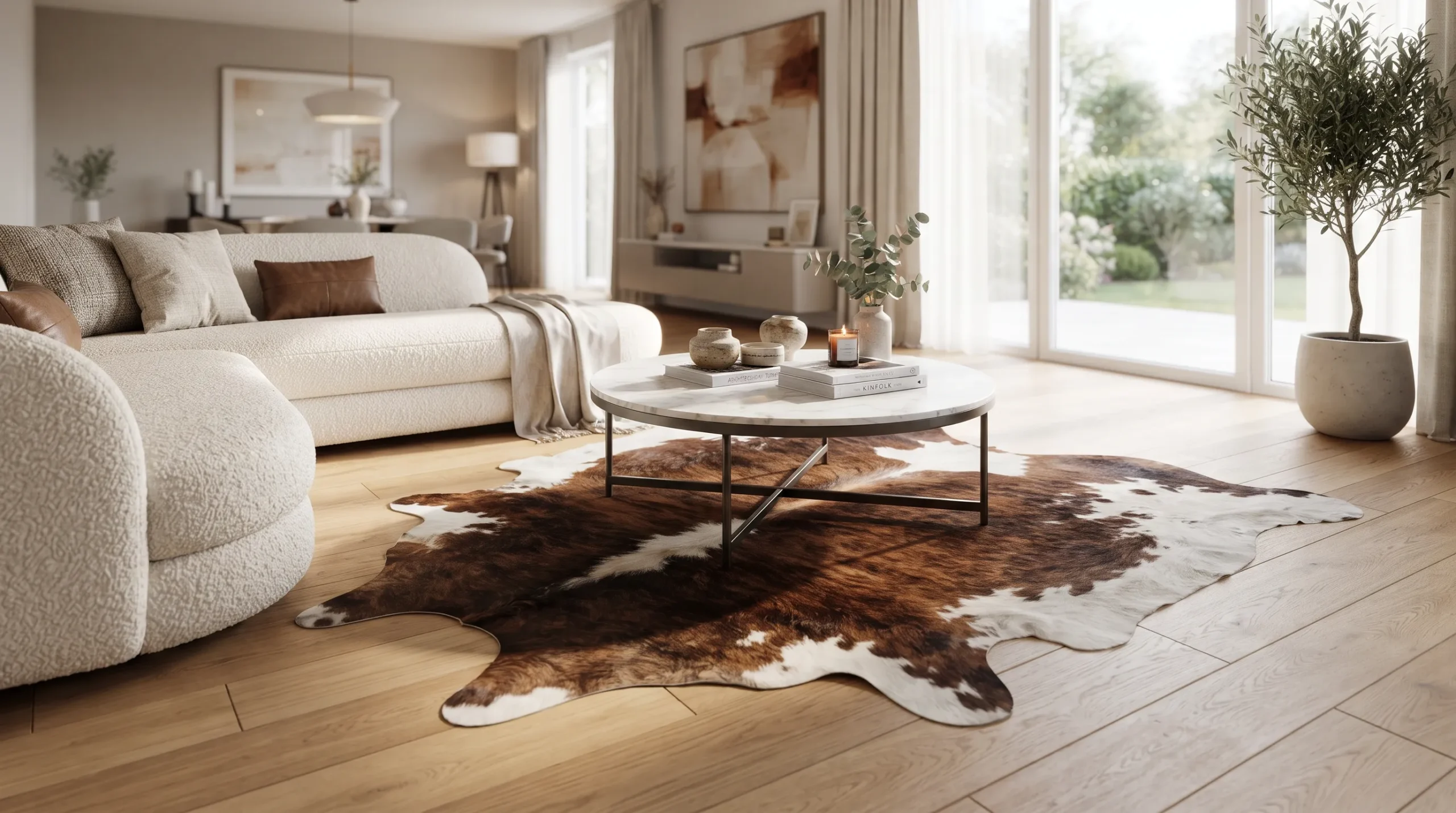
You have read through every major aspect of cowhide rug ownership—what the material is, how it is made, how different types perform in different rooms, how to size and color correctly, how to care for what you bring home, and how to evaluate a seller before you commit to a purchase.
What this guide comes down to, practically, is a handful of principles worth holding onto when you are ready to buy.
Choose Genuine Over Synthetic Every Time
The price difference between a genuine cowhide rug and a well-priced synthetic alternative narrows considerably when you account for lifespan. A genuine hide at $400 lasting fifteen years costs less per year than a synthetic at $150 lasting four. It performs better over that period, looks better throughout it, and does not contribute synthetic fiber waste to the environment when its useful life ends.
The cowhide market has enough synthetic products masquerading as genuine that this requires active verification individual hide photography, leather backing, and an asymmetric natural shape. The signals are clear once you know what to look for. Take the two minutes to confirm what you are actually buying before you add it to your cart.
Get the Size Right Before Anything Else
Color, pattern and style all matter, but an undersized rug in an otherwise well-designed room undermines everything else in the space. A correctly sized hide that anchors the full furniture arrangement is almost always more valuable than a slightly more interesting pattern in the wrong dimensions.
Measure your full furniture arrangement, not just the coffee table. Add 24 inches on every side of a dining table. Extend 18 to 24 inches past the foot of the bed. When choosing between two sizes, choose the larger one.
Match Color to the Room You Have
Cowhide color selection works best when it builds outward from the existing palette of your specific room the dominant warm or cool tones, the primary materials and the natural and artificial lighting conditions. A hide that looked perfect in someone else’s room is working within their specific material context. Yours is different.
Use the color and style guide in this article to identify which cowhide category best suits your room’s existing conditions. Then shop within that category with confidence instead of trying to recreate a look designed for another home.
Basic Maintenance Protects Your Investment
A genuine cowhide rug is not a maintenance burden, but it is not maintenance-free either. Shake it outdoors every two weeks. Vacuum monthly on low suction in the direction of hair growth. Blot spills immediately. Rotate the rug 180 degrees every six months.
These four habits take less than fifteen minutes a month and extend the functional lifespan of a quality hide by years. The difference between a hide that lasts eight years and one that lasts twenty is almost entirely in the consistency of this simple care routine.
Buy From a Seller Who Shows the Exact Hide
The single most important purchase decision you make in the cowhide category is not which hide you choose it is which seller you trust. A seller who photographs every individual hide before listing it gives you accurate visual information about a specific, unique piece. A seller using representative photography asks you to accept meaningful uncertainty about what will actually arrive.
Transparency in photography often reflects transparency in every other aspect of the buying experience, including sourcing, return policies, quality control and customer support. Buy from sellers who show you exactly what they are selling. It is one of the strongest indicators of a trustworthy brand.
Explore Ventinots Genuine Cowhide Rug Collection
Ventinots is a manufacturer-direct brand specializing in genuine cowhide rugs, handcrafted leather bags and cowhide accessories sourced from skilled craftsmen in Pakistan and fulfilled from its Texas warehouse.
Every hide in the Ventinots collection is individually photographed before listing. The rug shown in the product listing is the exact rug you will receive. Each piece is carefully inspected at the source, again before photography and once more before dispatch to ensure consistent quality.
Why Buy From Ventinots?
- Every hide is individually photographed, so you receive the exact rug you select.
- Manufacturer-direct pricing with no unnecessary wholesale markups.
- Handcrafted by skilled leather craftsmen with generations of experience.
- Multiple quality inspections before photography and shipping.
- Fast domestic shipping from the Texas warehouse.
- 14-day return policy for added peace of mind.
- Direct customer support via phone, email, and WhatsApp.
If you are ready to choose your perfect cowhide rug, browse the Ventinots collection with confidence. Take your time exploring the photography because every listing features the exact hide available for purchase. Every rug is naturally unique, and the right one for your home is waiting for you.
